By Abel Shicoi, Special to the Journal
Every day on the news, it’s expected that you will hear updates about the U.S. Immigration and Customs Enforcement (ICE) with topics including new policies, recent activity, and the death of innocent civilians. With constant access to footage via social media, we are persistently being bombarded with information that can lead to feelings of existential dread. The simplest solution to this is choosing to block it out, though many people don’t have the luxury of taking this route. Those who are being directly targeted by ICE most likely feel it’s necessary to monitor ICE activity in the surrounding area so they can protect themselves and their family.
It is important to note that ICE was present during Biden’s presidency – however, during President Trump’s current term, the number of people being held in ICE detention facilities has increased by more than 75 percent in one year.
ICE is Here
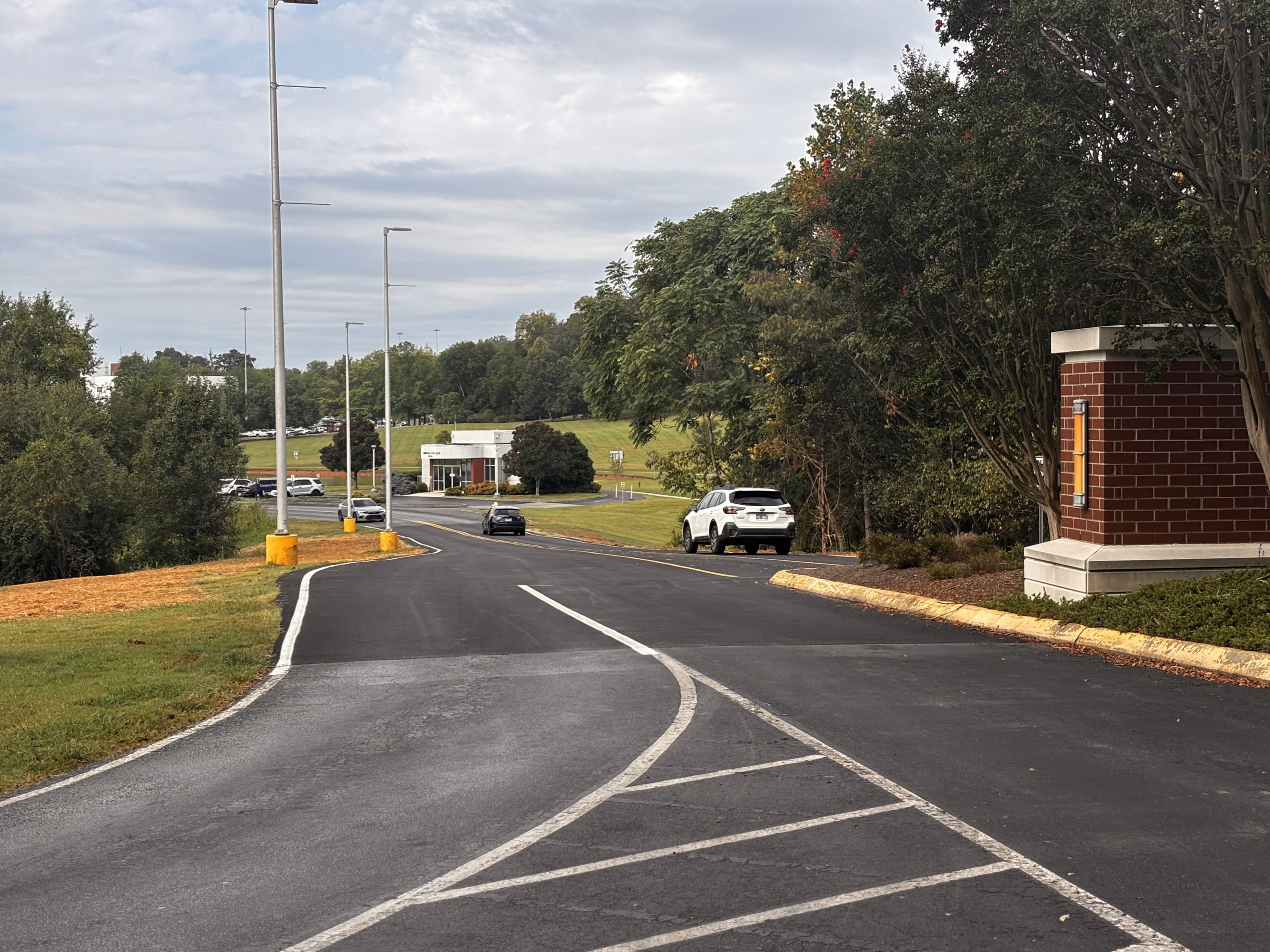
Recently, ICE has become more and more active in our community, specifically in Hardin Valley. On January 13, ICE conducted a raid at a construction site within one mile of both Hardin Valley Middle and High School, and our very own campus. During this raid, workers ran into the woods behind the construction site in an attempt to escape being detained, while ICE agents followed into the woods after them. Based on local reporting, it is unclear how many people were detained that day; however, two contractors were charged with “conspiring to disrupt Immigration and Customs Enforcement officers.”

Tennessee is the ‘Model State’
White House Deputy Chief of Staff for Policy and Homeland Security Adviser Stephen Miller has partnered with Tennessee Republicans to develop legislation that will serve as a “model for the rest of the nation,” with the goal of the state becoming a template that other states could follow. Within this legislation, there are many bills being proposed that impede upon constitutional rights, specifically the Equal Protection Clause under the 14th Amendment. The bill that is most relevant to students requires Tennessee schools to verify the immigration status of students, backed by another bill that supports the denial of enrollment if K-12 students fail to produce proof of their citizenship.
KCS’s Stance
In response to recent ICE activity, many parents are concerned for their children’s safety while attending public schools. A Knox County School spokesperson said, “In accordance with state and federal law, we do not maintain records on the immigration status of students.” KCS Superintendent, Dr. Jon Rysewyk, claims that they will follow the law and comply with officers while verifying legal documentation before law enforcement enters the classroom. Rysewyk claims that ICE has not asked to enter any KCS classroom, yet.
With emerging legislation and ICE raids being conducted so close to campus, many of us are asking the same question: What happens if ICE comes to Pellissippi?
What Can Faculty Do?
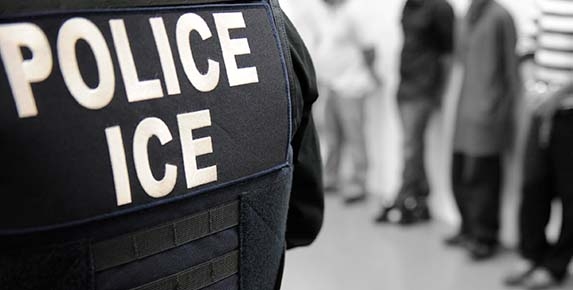
Faculty can legally lock their classroom door, but if a law enforcement officer asks to enter and shows their badge, they are asked to comply with their orders. Since classrooms are considered private spaces, ICE agents must have proper documentation, including a signed warrant by a judge. The college has directed faculty to call campus police if they do see ICE activity on campus or if a law enforcement officer is asking to enter the classroom.
In the most recent Faculty Senate meeting on Wednesday, January 28, Campus Chief of Police Terry Crowe answered a multitude of questions pertaining to immigration policy on campus. When asked if he would be protecting ICE or protecting students and faculty, Chief Crowe responded with, “My goal is to protect everybody. Everybody gets protected in the process. If there is a legal process taking place, then I have to, if I have the paperwork, allow that process to happen.”
Chief Crowe mentioned that, in the past, he has been in contact with local law enforcement relating to both criminal activity near campus as well as situations involving campus. Despite this, Crowe was not informed by local or federal law enforcement that previous ICE raids would be taking place within a mile of the Pellissippi State Hardin Valley campus. To the contrary, Crowe states that,
“I have no indications that Immigration and Customs [Enforcement] have plans to be on campus. I don’t anticipate that happening. I do think if it were to get to that point, I would be informed.”
We attempted to get a follow-up interview with Chief Crowe after last year’s story, “Here for a Better Life”: Pellissippi State Students Express Concern for their International and Immigrant Peers,” but he stated that his “[G]uidance to our employees and students is the same.”
FERPA Protects Students
The Family Educational Rights and Privacy Act (FERPA) protects the privacy of student records, meaning that faculty are not required to provide any information regarding their students to law enforcement officers. Even though faculty members don’t have access to the immigration status of their students, if they were to have this information, FERPA is in place to protect students from their private information being shared. Furthermore, both classrooms and offices are considered private spaces. In the circumstance that a law enforcement officer disrupts a classroom and claims that it is their First Amendment right to do so, faculty members are not legally required to provide any information about their students.
“A classroom, in my opinion, is not a public space,” Chief Crowe says. “A classroom is where academic activities are taking priority over anything else. I am very cautious of our officers even coming into a classroom. We try to avoid that at all costs… But if someone were to come into that class and disrupt it, and say that that was their First Amendment right to disrupt the class, that is not the case.”
Conversations With Faculty
Many faculty members are concerned for the safety of their students and are searching for ways to protect their classrooms amidst the threats of a potential ICE raid. In order to have a better understanding of how faculty members are approaching this subject, we conducted a couple of interviews.
“I would fight for my students and try to help them be as safe as possible, because we don’t know if they’re safe once they’re leaving my classroom,” a faculty member who spoke on the condition of anonymity said.
They added that, “I’ve had quite a few students mention that they’re stressed either for themselves or loved ones. And in a lot of cases, they are natural-born citizens. As a professor, I’m not really sure what to provide for them, because they’re just scared of this environment where they know they’re not protected because they’re a person of color.”
When asked, “How do you think the college should respond to ICE if they came to campus,” Assistant Professor Carlena Crase responded, saying, “Not help. Not help at all. Once again, they can diffuse the situation and do what they can in order to make sure that their students are safe. That should be our priority, making sure our students are safe. And so my suggestion is to not help whatsoever, get them off of our campus as soon as possible.”
“It would be great in terms of Pellissippi [State] coming together as a whole, like the president, the vice president, the people who have these higher positions to acknowledge what’s happening and to showcase that they care, they will back up their faculty, their staff, and their students because then that shows that they see us,” she added.
What Can Students Do?
In the circumstance that ICE is present on campus, students can approach this situation similarly to an armed intruder lockdown, i.e., hiding in the classroom. Students and faculty also are legally allowed to film any law enforcement officer, but if asked to back up, they are legally required to stand 25 feet away from officers, according to SB0030. If asked to stand back, students should make sure to turn their camera down and record their feet moving backwards, so that they have evidence of complying with orders.
Voice Your Opinion
We have created a fully encrypted and anonymous survey to provide the space for you to express your feelings towards possible ICE presence on campus. Please only fill out the survey if you are a student, staff, or faculty member at Pellissippi State Community College.
Know Your Rights
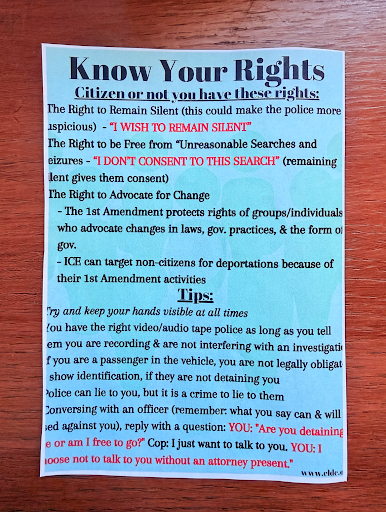
Knowing your rights will equip you with the necessary information that will hopefully protect you if and when encountered with ICE or other law enforcement.
1) The Right to Remain Silent: The 5th Amendment protects your right to remain silent, meaning you are not required to share any personal information, including your immigration status, place of birth, or criminal history.
2) The Right to be Free from Unreasonable Searches and Seizures: The 4th Amendment states that a signed warrant is required to proceed with any searches of personal items or spaces, and arrests or detainments. Make sure to say “I don’t consent to this search,” because remaining silent is considered providing consent.
Hotline
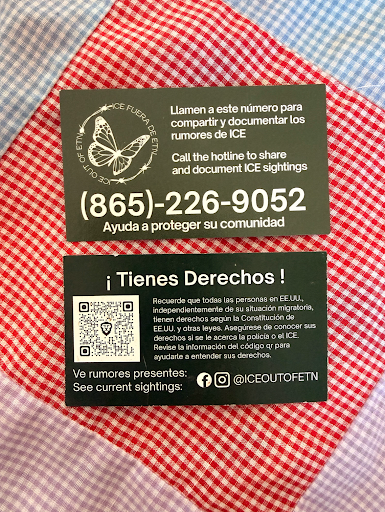
If you notice any ICE activity, Department of Homeland Security (DHS) activity, or U.S. Customs and Border Protection (CBP) presence, you can call the ICE Out Of East Tennessee (IOETN) hotline: (865)-226-9052. You can also DM them on social media, including Instagram and Facebook. To access the hotline easily, the number can be saved in your phone as a pseudonym. When reporting ICE activity, follow the acronym SALUTE: S-size/strength, A-actions/activity, L-location/direction, U-uniform/clothes, T-time and date, E-equipment and weapons.
Resources
1) Immigrant Legal Resource Center: ILRC is an organization that has an ample amount of legal information, including both federal and local resources.
2) Allies of Knoxville’s Immigrant Neighbors: AKIN is a local organization that works to support and learn from immigrants and refugee communities within Knoxville.
3) ICE Out of East Tennessee: According to their profile, “IOETN is a grassroots organization that works to build community alternatives to ICE and policing in East Tennessee.” You can follow them on social media to receive updates of current ICE presence within the region.
Conclusion
ICE is here, in Knoxville. If they come to Pellissippi State, hopefully the information provided will assist you in how to approach that situation. It is apparent that students and faculty are fearful of ICE presence on campus.
Although Chief Crowe has provided instruction on how to cooperate with ICE, faculty is asking for adequate guidance to reassure their students that safety is a priority of the college. Remember to fill out this fully-encrypted and anonymous survey concerning your feelings about ICE and the possibilities of their presence on campus.
Abel Shicoi is a pseudonym for the writer of this story.