By Bean Gast, Staff Writer
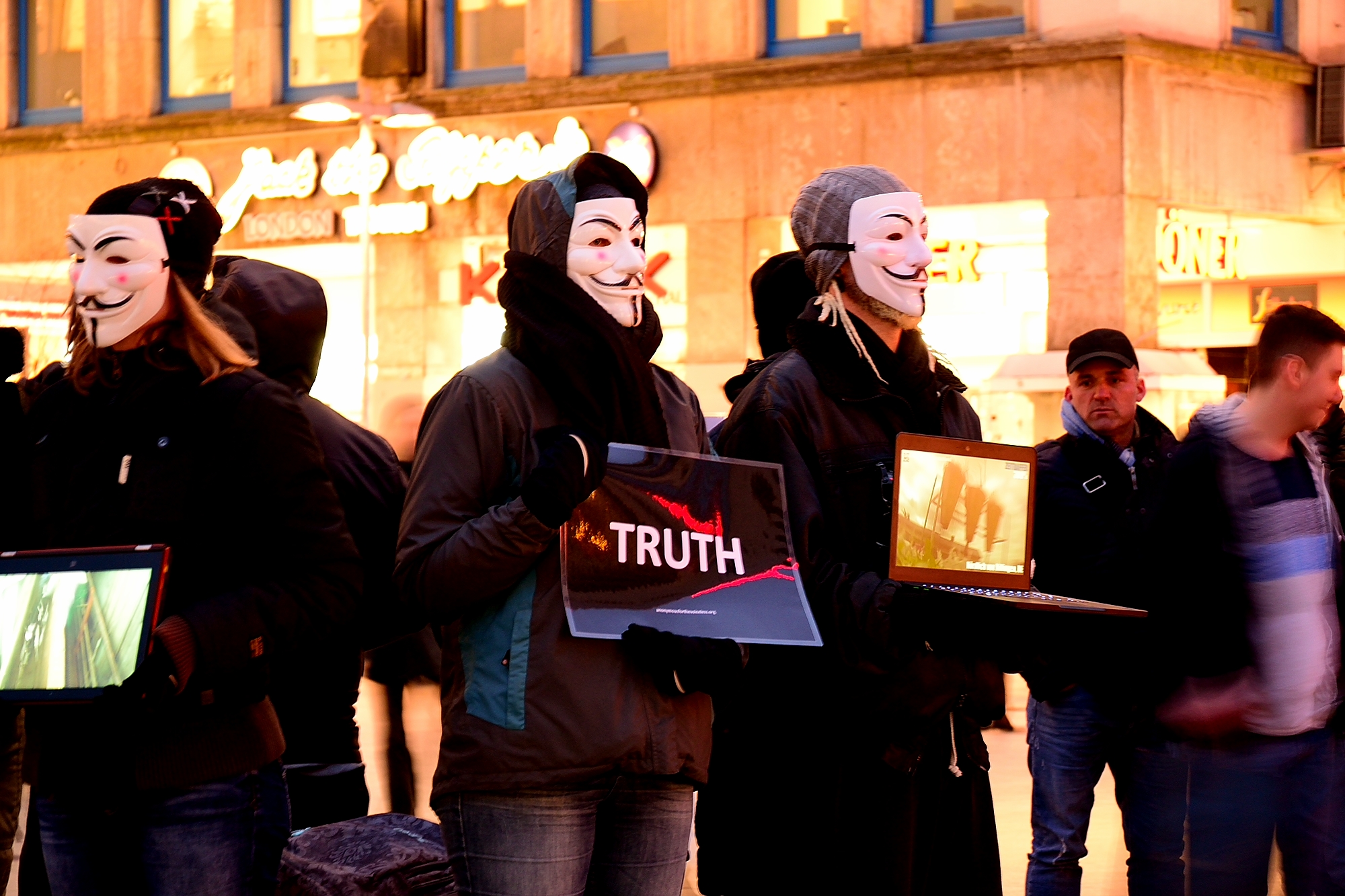
It’s not often that I watch a horror movie that I’m unable to finish; however, I only made it 15 minutes into Earthlings, a documentary about the animal exploitation industry. The reality of how we USE animals in society is actually horrifying.
Inside the Dairy Industry
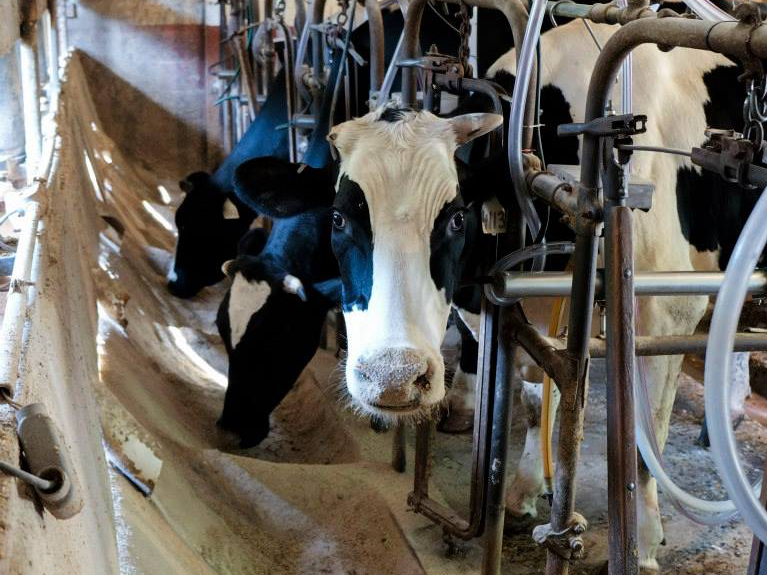
As a result of a growing population, a demand for dairy, and lack of land, dairy cows in the United States are forced to live their lives in sheds without access to a pasture, a concept called “zero grazing.” They’re typically chained by their neck, tagged with a number, and so close in proximity to one another that they’re unable to move, standing in their own feces.
Many people don’t realize that a cow has to give birth in order for them to produce milk, similar to other mammals who biologically produce milk to feed their young. The nutrients in the milk are specifically designed to promote growth for the calf, so why are we consuming it? Humans are the only species of animal that drinks another species’ breastmilk. Let that sink in.
In order for cows to become pregnant they are aggressively artificially inseminated, a process where someone shoves their arm into the cow’s rectum with an insemination gun while manipulating the cow’s cervix to deposit the semen within their uterus. Though that description may seem graphic, it’s the reality of the dairy industry. Anyone with a uterus who’s gotten a pap smear would know it’s an unpleasant experience – no one is looking forward to it. I imagine how painful this procedure would be, let alone an invasion of bodily autonomy. An important reminder: just because cows are a different species, doesn’t mean they are immune to pain.
The entirety of the dairy industry is based on the exploitation of the female reproductive system, as it wouldn’t exist at all without sexually violating someone and forcing them to give birth. Animal rights activist, Calen Otto, says,
“You’re literally hijacking someone’s reproductive system and forcing them to give birth all so you can drink or profit off of their breastmilk. It’s a huge violation of female rights, regardless of species. Because we normalize it so much it doesn’t help us, it doesn’t help us as female humans. Any exploitation in one sector is always going to be connected to the other.”
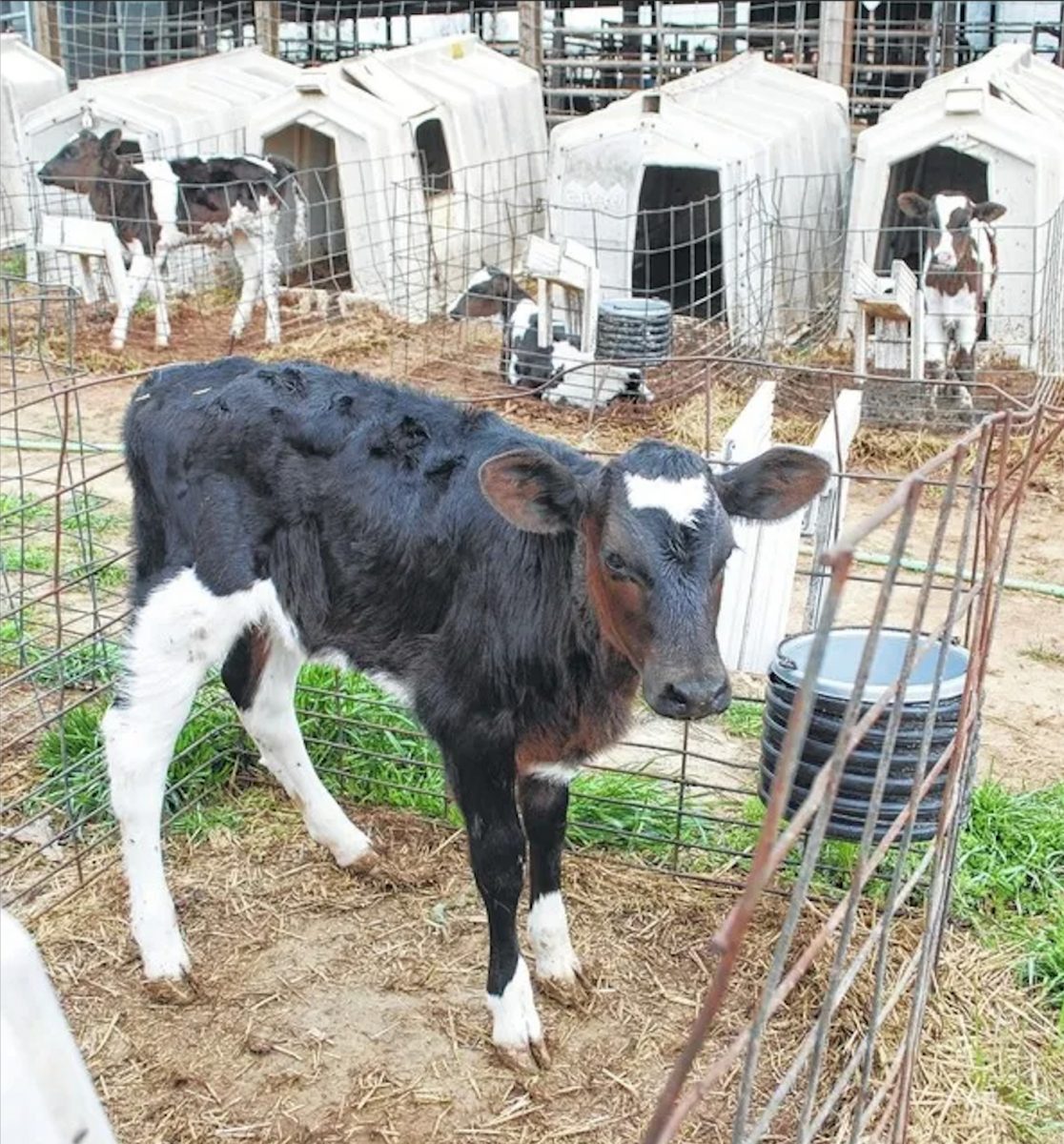
After the cow gives birth, their baby is taken away from them within the first 24 hours, a heartbreaking experience for both the mother and the calf. If the calf is male, they will immediately be slaughtered to be sold as veal and, if the calf is female, they will be recycled into the dairy industry. Leslie Naylor, owner of 4Them Sanctuary says,
“The most horrifying part of the dairy industry is: as a mother and as a woman, taking that baby away from them after carrying them for nine months like we do. I did that twice and one of my daughters was taken from me by cancer, I know the devastation.”
The cows are milked 2 to 3 times a day by a machine that vacuums out their milk, sometimes causing their udders to be inflamed. Typically two months after giving birth, the cows are artificially inseminated again, the cycle repeats. Over and over these cows are being sexually violated, carrying their baby for nine months, and getting their baby ripped away from them. Once the cow’s milk production decreases, they will be sent to be slaughtered; meaning, the dairy industry and the meat industry are interconnected, just disguised in different ways.
What About “Humane” Farms?
Many farms will label themselves as humane without a certification, but does a certification guarantee the practice is humane? Can sexually exploiting someone be considered humane?
To answer this question, animal rights activist Calen Otto toured over a dozen small dairy farms in Western North Carolina to see if their claims of being “humane” were accurate. The tours would typically show off the animals who were kept in clean and open areas, though it took some curiosity and questioning to see behind the scenes. They discovered atrocities that were equivalent to large scale dairy productions, saying of one farm that “[the cows] were all in these tiny, tiny hutches, chained up by the neck.” Despite this, the tours were presented by farm owners to be wholesome and personable while describing the exploitation and slaughter of these animals. Otto goes on to say,
“I found the experience disturbing because of how normalized the sexual violation is, the slaughter, and the dominance over someone else’s reproductive system.”
Environmental Effects
Factually speaking, the animal agriculture industry is the leading cause of climate change, due to the emissions of methane gases specifically from cows. Not only is our atmosphere being negatively affected, water sources and soil is being contaminated with animal waste. Additionally, more water is used to grow the grain or soybeans we feed cows than we use to grow our own food; if you add in the water that the cows consume, the statistics exponentially increase. Whether cows are contained within a factory or grazing within a field, they still take up a huge percentage of U.S. land mass; the land that was previously inhabited by wildlife, is now being used to torture and eat animals. Animal rights activist and journalist Jeremy Loeb says,
“We also know that methane pollution is one of the most potent greenhouse gases, and methane pollution in the beef and dairy industries is extremely high. We couldn’t even get a hold of climate change if we didn’t stop the use of cows in our food system. There really is no climate solution without ending the dairy industry or the beef industry, in my opinion.”
I think this is a particularly interesting observation because it really is that simple. It’s clear we have the evidence and statistics to prove the dairy and beef industry produce an immense amount of greenhouse gases, so why aren’t we reducing our consumption of these “products?”
Government Influence
Through subsidies, the government literally funds the dairy industry in their capitalistic pursuit to profit off of the people. Our government recognizes that the dairy industry is simultaneously the most vulnerable and the strongest industry; meaning that as soon as the people stop buying the product, the industry will cease to exist.
Through the influence of the USDA, the dairy and meat industry lobbied their way into the school systems to create the food pyramid. The dairy industry capitalized on children and parents claiming that milk will make children big and strong, additionally catering to adolescent boys by taking advantage of their insecurities and portraying that milk will make you more masculine. Suddenly, milk became a necessity in our diet, despite the fact that humans were not even designed to consume another species’ breastmilk.
The Got Milk campaign is another example, where celebrities are portrayed with a smile on their face and a milk mustache, displaying how delicious and nutritious milk is.
Dairy and Colonization
Cows were originally brought to the Americas by the European colonizers who insisted upon the consumption of dairy; prior to the arrival of the colonizers, Native Americans did not have any dairy producing animals. The production of cattle encouraged the expansion of lands, a catalyst in fueling the conquest of territory, meaning natives were conquered by both the colonizers and their animals. The way we view animals today is a direct reflection of the colonizing of native lands; Native Americans utilize every part of the animal, while Americans treat animals like they’re disposable, discarding everything except for what is needed for the industry. We still see the huge effects of colonization and drinking milk as animal rights activists and journalist Jeremy Loeb expands,
“And in the case of dairy and eggs, we’re viewing animals like they are our own vending machine, like we can just take from them.”
My Story
Five years ago I had an epiphany that led me to stop eating animals and stop consuming their products. I realized that I was a hypocrite for advocating my bodily autonomy while continuing to exploit the bodies of so many animals. How could I respect my own body and ask that of others if I couldn’t respect the bodies of similar beings? Loeb summarizes this perfectly,
“It’s one of these huge blind spots that people have, just because someone happened to be born in a different body than we were, suddenly it’s okay to do this to them. We know that’s wrong.”
Final Thoughts
Owner of 4Them Sanctuary, Leslie Naylor has been vegan for 16 years and says, “I’ll be sixty this year and I just hope before I leave this Earth, I can see the dairy industry crumble.”
Will the dairy industry fall? Will it crumble? The fate of the dairy industry lies in our hands, we hold the power. To recognize the sacred power that female bodies possess to bring life into this world and to then steal their power and exploit it, is pure evil. Decolonize your diet and end the exploitation.