By David Lavrinovich, Alumni Editor
The 2026 Winter Olympics were a beautiful display of the human spirit, as athletes from around the world showed up to show off their talents. The games strive to be as apolitical as possible, leading the International Olympic Committee (IOC) to have strict regulations on which countries are present and how the athletes are allowed to conduct themselves. Yet several incidents of enforcing these rules this year have proven that even supposed impartiality has its controversies. Ironically, the IOC’s insistence on maintaining neutrality only spotlights how politics permeates every level of the Olympics.
Foundation of the Olympics
The origin of the Olympics lies in Ancient Greece, where contests were organized every four years at the city of Olympia. It was as much a sports spectacle as it was a religious festival. The Olympics, as you may know them, didn’t take form until the establishment of the International Olympic Committee in 1894. The changes made featured current sports and encouraged international participation, culminating in the first modern iteration of the Olympics in 1896, hosted by Athens, Greece. Other hallmark traits of the current Olympics are the sheer number of regulations in place. Two regulations in particular, the Olympic Truce and Rule 50, were extremely relevant to this year’s Winter Olympics.
The Olympic truce is an ancient tradition in which a treaty was made so that all athletes and spectators could enjoy the games in peace. This tradition continues to this day, as the IOC promotes a period of no conflict before and after the competition. In essence, countries engaging in international conflict are banned from participation in the Olympics.
Rule 50 of the Olympic Charter limits the demonstration of any sort of political views. It also effectively prohibits demonstrations and protests in any area where Olympic events are taking place. Any athlete in violation of Rule 50 will be evaluated and disciplined on a case-by-case basis.
The IOC maintains the Olympic Truce and Rule 50 in order to build a better world. Its intention is to promote the Olympic ideal so that sports and healthy competition can foster peace between nations. Thus, these regulations play a huge role in determining countries’ participation and expression, and are important for understanding the role of politics at the Olympics.
Who Gets to Play?
The 2026 Winter Olympics had athletes from every continent to form a legion of over 3,500 competitors. These athletes played for 93 national Olympic Committees; for simplicity’s sake, these committees and athletes are more commonly referred to by the countries they represent. With statistics like those, it seems that any athlete from any country can participate; however, climate and money pose significant barriers for many nations. This is especially prevalent for the Winter Olympics, in which all the sports require snowy or icy terrain. Not to mention that the sports in the Winter Games tend to be more expensive and require specialized training than those in the Summer Olympics. Hence, athletes from countries with the right geography and strong economies have an unspoken advantage, which is inherently political, yet the IOC does not acknowledge this.
Additionally, the IOC has taken a political stance by having allowed for Iran, Israel, China, and the U.S. to participate, despite their own controversies. The Islamic Republic of Iran has massacred and continues to kill thousands of its own citizens amidst the 2025-26 Iranian protests. Despite a ceasefire agreement, the State of Israel perpetuates an ongoing genocide and displacement of Palestinians within the Gaza Strip. The People’s Republic of China continues to persecute and commit human rights abuses against its Uyghur population, a minority ethnic group. The United States of America maintains human rights violations and systematic violence towards immigrant communities through mass detainments and deportations. Apparently, none of these were reasons enough for the IOC to keep any of these countries from participating. In fact, there are only two countries that have remained “banned” from the Olympics due to their transgressions.
For their actions regarding the war in Ukraine, Russia and Belarus were not allowed to participate in the Olympics. However, a special exception was made for competitors from those countries who were allowed to participate as Individual Neutral Athletes. Simply put, these competitors were not representing the national Olympic committees of their countries, and were not allowed to participate in any team sports. These athletes were strictly screened to guarantee they were not in support of the war against Ukraine, including their social media, relations, employment, and more.
Seeing how all of these highly controversial countries have violated the Olympic Truce and are still allowed to compete proves that the Olympics’ political neutrality is a facade. Even though the IOC isn’t showing support for these governments’ harmful actions, they aren’t exactly reprimanding them either. In fact, the IOC seemed far more interested in censoring certain athletes instead.
Personal Expression
While other countries donned patriotic uniforms with no trouble, Team Haiti and Team Ukraine both faced heavy restrictions during this year’s Winter Games. The IOC invoked Rule 50 when censoring their outfits, stating that they were too political for the games.
When designing the uniforms for Team Haiti, Italian-Haitian designer Stella Jean based her work on a famous painting of Toussaint Louverture atop his trusty steed. Haiti was a former colony of France before becoming the only successful slave revolt in history, in large part due to Louverture’s actions. However, Jean was told that she could not depict Louverture, as he was a political symbol. Instead, the outfits would feature a horse, fully saddled, but with no rider.
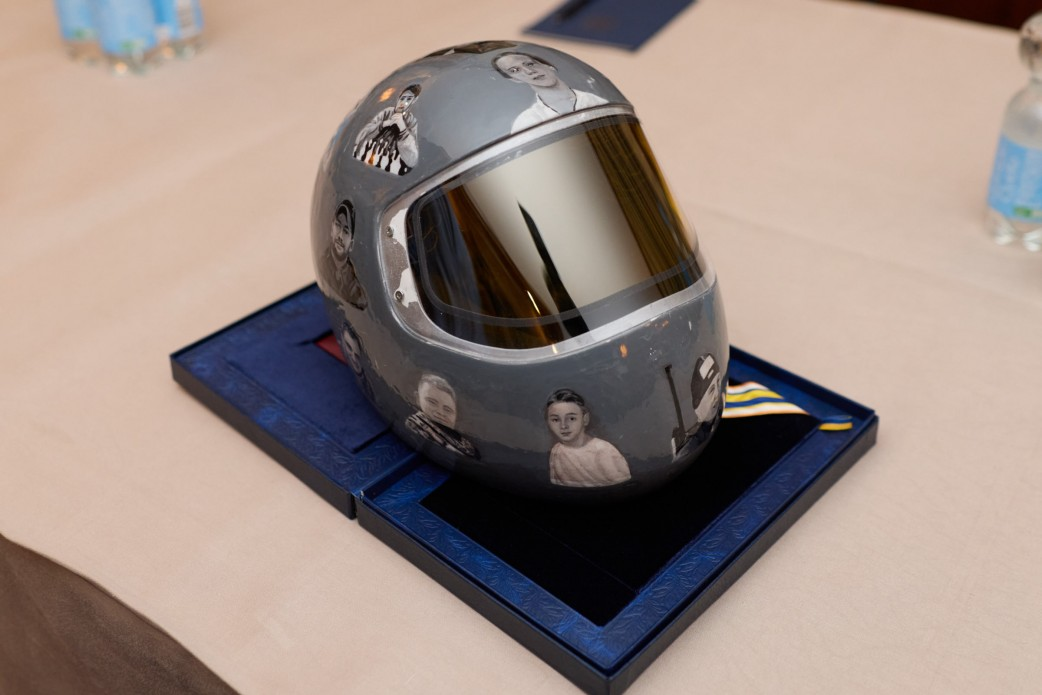
Ukrainian athletes and the patriotism displayed in their uniforms were similarly suppressed. Not one, not two, but three separate Ukrainian competitors had their personal expression silenced. All three occurrences involved personalized helmets displaying various pro-Ukrainian sentiments. Freestyle skier Kateryna Kotsar had to remove “Be Brave Like Ukrainians” from her helmet. Similarly, speed skater Oleh Handei was banned from using a helmet that quoted poet Lina Kostenko, “Where there is heroism, there is no final defeat.” Most egregiously, the disqualification of skeleton racer Vladyslav Heraskevych for refusing to remove his “Helmet of Remembrance.” The piece honored Ukrainian athletes killed in the war by displaying their images.
Conversely, the IOC paid no mind to two other athletes who had similar political symbolism in their uniforms. Jared Firestone from Team Israel donned a kippah with the names of Olympians killed in the 1972 games in West Germany. Meanwhile, Roland Fischnaller, who was competing for Team Italy, was not prohibited from wearing a Russian flag on his helmet. This is even more hypocritical, as Russians competing as Individual Neutral Athletes weren’t even allowed to wear the Russian flag. When comparing these incidents, it’s incredibly apparent how the IOC cherry-picks its political matters.
The Way Forward
If there is anything that this year’s Olympics have proven, it’s that politics are inherent to the games. The attempt to remove politics is a futile effort when considering that the competition is between countries, which are distinct political entities. Furthermore, even when removing explicit politics, the Olympic stage still offers nations the chance to leverage soft power and cultural influence on a global scale. For the IOC to silence politics in the name of neutrality does a disservice to the nations that have been, and still are, impacted by war, genocide, and colonialism. In fact, to act as such shows favoritism to countries that perpetrate harm to their denizens and/or other nations.
The issue of politics in the Olympics is multifaceted. As an international organization and globally watched event, the Olympics’ unique position means that politics is inescapable. Nevertheless, one thing remains clear. In the face of so many modern global conflicts, neutrality is complacency. The Olympics need to stop avoiding politics and stand firmly behind oppressed nations. Only then can the Olympics start working towards its goals of sportsmanship, unity, and peace between nations.