
By Patrick Dobyns, Opinion Editor
In August of 1920, the United States ratified the Nineteenth Amendment to the Constitution. This important addition to the document finally declared that the right to vote could not be denied on the basis of sex; effectively, women had gained the right to vote for the first time in American history. This milestone was not achieved overnight, though.
The first women’s suffrage amendment was introduced in 1878, and it didn’t clear the House of Representatives until 1919, over forty years later. After that, it was quickly ratified by the Senate and was handed over to the states for ratification, requiring 36 to ratify it before it could become an official Amendment to the Constitution.
Immediately, women’s suffrage movements sprang into action, campaigning for the right to vote and pressuring state legislatures to ratify. Southern Democrats (which, it is important to note, is not the same political party it is today) proved to be the most difficult to sway, with Texas and Arkansas being the only former Confederate states to ratify the amendment before the summer of 1920. The majority of the rest of the Southeast, from Delaware to Louisiana, had either rejected the amendment or had not yet voted. But, in June of that year, 35 out of the needed 36 had ratified it, and only one more state was needed to vote “yes” for it to be accepted before the 1920 elections.
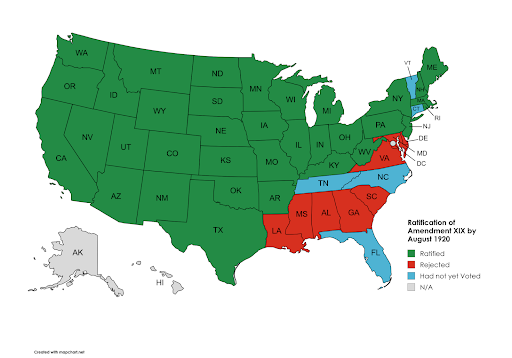
Of the remaining states, there was little hope. Vermont and Connecticut would be the most likely to be able to vote for ratification but, due to corporate opposition, the governors of those states refused to call their legislators into session. Florida had not shown any interest in calling a vote either, and North Carolina was already in the process of joining the other Southern states in rejecting it. This left Tennessee as the suffragists’ best chance of obtaining the vote.
Tennessee was the last hope for suffragists to pass the bill before the 1920 elections, but it was far from a sure thing. Although the governor was a Democrat, there were still many in the state government who were Southern Democrats and opposed the idea of women’s suffrage on the basis that it would further enfranchise Black voters. Carrie Chapman Catt, president of the National American Women Suffrage Association (NAWSA), did not believe there was “a ghost of a chance” to get ratification in Tennessee, yet still she campaigned along with suffrage leaders of the state, such as Anne Dallas Dudley and Abby Crawford Milton. They were facing off against a group colloquially known as the “Antis,” led by the president of the Southern Women’s Rejection League of the Susan. B. Anthony Amendment, Josephine Pearson. Both groups began intensely lobbying state lawmakers to choose a side.
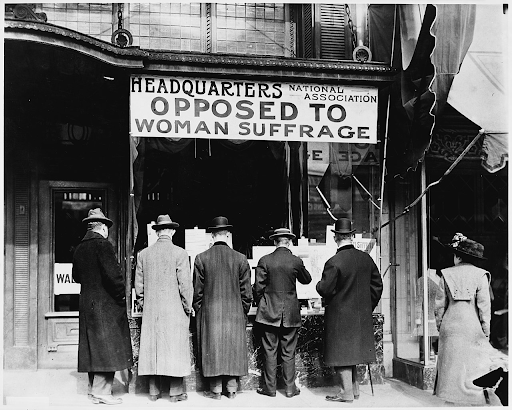
For those who felt strongly, either for or against ratification, loyalties became clear with the appearance of rose lapels. Those who supported suffrage wore gold, a color commonly used by members of NAWSA for its symbolism of purity and hope. Those who opposed suffrage wore red roses as a response, also symbolising more traditional values. If one was ever in doubt as to which way a lawmaker was going to vote come the General Assembly, they needed only to look at his lapel. This battle became jokingly referred to as Tennessee’s War of the Roses. When the General Assembly began, both Suffragist organizations and the “Antis” set up stalls to hand out roses.
On August 12, the State Senate voted easily in favor of ratification, with 24 votes for and five votes against. The House was up next on August 18, but was much more difficult in its proceedings. The Speaker of the House voted to table the issue completely and was only defeated by a tied vote of 48-48; when he tried a second time, he got the exact same result. Among those who had voted to table the issue was Republican Harry T. Burn who represented McMinn County. He had rejected the ratification on the basis that his constituents did not support it but before the third vote, he received a letter. After reading it, he changed his vote from “nay” to “yea,” and the Nineteenth Amendment was officially ratified in the state of Tennessee, becoming the 36th state to do so and paving the way for the amendment to make its way to the U.S. Constitution.
What was that letter which had changed his mind, and made him vote with his conscience rather than his constituents? Although it was short, the first two words probably did most of the convincing: “Dear Son.” In it, she expresses her own support for suffrage, and states that she’d “been watching to see how [Harry] stood but have not seen anything yet.” In perhaps the most important example of passive aggression in U.S. history, she urged her son to “remember to be a good boy,” and became the deciding factor in granting all women the right to vote.
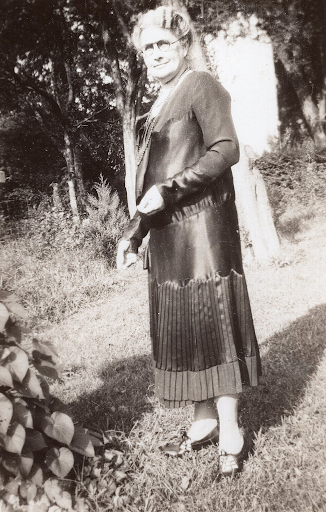
When later asked to justify his decision, after having had to climb out a window to escape a mob of anti-suffragists, Burn later said, “I knew that a mother’s advice is always safest for a boy to follow, and my mother wanted me to vote for ratification.” Over the next few decades, those states that either did not vote or voted against the amendment ended up ratifying it, the last being Mississippi in 1984. Despite this, Burn would later campaign against the Equal Rights Amendment (ERA), which would have prohibited discrimination on the basis of sex in any regard, saying it would be a “great loss of rights for women.” To this day, equal treatment under the law based on sex is not guaranteed under Federal law.