By Addison Chrivia, Editor
I would like to start by saying that I found The Bride! very fun to watch, I enjoyed myself and the visuals were stunning and at no point was I bored. However, was it an objectively good movie? No, no it was not. Between the plot holes, unexplored characters, the focus on Frankenstein’s creature instead of the titular Bride, and the overwhelming amount of things that happen just make it seem like the kind of movie that was sewn together in the dark.
There is so much going on simultaneously in this movie that it crowds the plot, juggling so many characters and subplots that it’s really impossible to narratively fulfill the need for closure for all of them.
Plot Summary
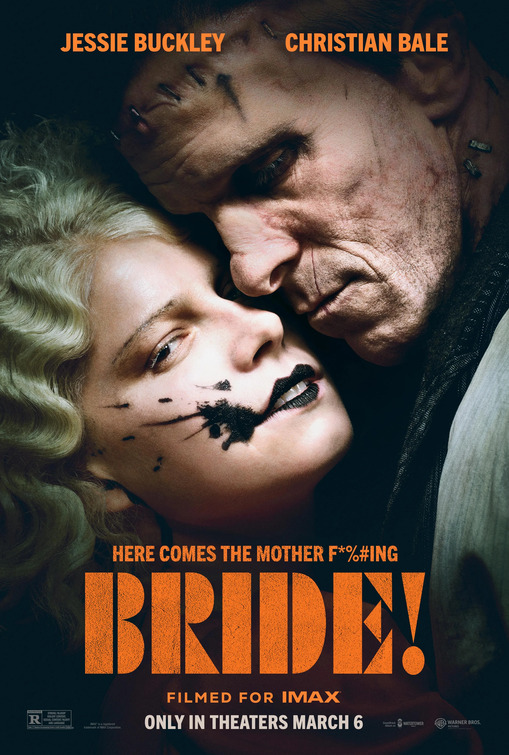
To start, we have the main storyline with the Bride, who is reanimated by Frankenstein’s creature – who goes by Frank in the film – with the help of a coincidentally mad scientist, Dr. Euphronius, because he is lonely. Frank and the Bride visit a club and are assaulted on their way out, ending in the protagonists killing their assailants; more specifically, Frank ends up curbstomping them into the ground. This, of course, gets the cops on the lookout for them, and they go on the run killing others who hinder their escape.
At one point they hide in a fancy party, where they and the guests are forced to dance jerkily to “Puttin on the Ritz;” why this happened is not explained and there is never another dance sequence in the movie. After holding one of the guests hostage and pointing out the corruption of the police force, the Bride leaves, her outburst inadvertently creating a movement called the ‘Violent Femmes,’ as women across the country dress up as the Bride and riot in the streets, attacking and killing their oppressors.
Afterwards, the two go on a Bonnie and Clyde type adventure, committing crimes, having sex, and watching old films, until The Bride finds out she was reanimated. This contradicts what Frank had told her, as he had previously explained that she was his fiancée who simply had an accident – we’ll get more into the consent issues of this later. This sparks the Bride to truly discover herself in an epiphany that, while she is The Bride, she is not Frank’s Bride. Frank is then shot in front of her by the police, and all that character development is completely thrown away.
While the Bride and Frankenstein are on the run, we are also shown the perspective of the detectives chasing them. The official detective is a charming and funny man, Jake Wiles, who is better at, as he says, seducing the local law enforcement and getting information that way. His partner, Myrna Malloy is extremely intelligent, picking up clues and patterns – it’s immediately clear that she is the brunt force behind their investigations. She specifically asks Jake for him to help her become an official detective after this case, especially considering that she is the one doing all the work. He claims that, while he wants that for her, he isn’t in charge of that decision and the captain of the police force would never agree. Later, he resigns, giving his badge to Myrna, effectively forcing her to finish the case on her own.
Jack Wiles eventually reveals that the Bride used to be a woman named Ida who worked undercover as a sex worker selling to the mob. However, the captain of the police force shut down the operation because he was paid off. The story constantly alludes to higher corruption in the elites and those in authority, but there isn’t really a central character we learn about or anything of substance that this subplot leads to. There are maybe two minutes total of screen time for the mob boss, who cuts out the tongues of women and keeps them in jars. He sends one of his men after the Bride to kill her, and we see the hitman following her around the entire movie, failing at every turn.
It’s also worth mentioning that, throughout the movie Mary Shelley made random appearances as an internal influence of the Bride, either speaking through her or, in dark cut scenes, speaking directly to the audience or the Bride, in her mind. There were some fun easter egg references to Shelley’s history, such as the fact that she kept her dead husband’s heart on her wrapped in a poem he wrote, and allusions to her mother, Mary Wollstoncraft. However, why she was present was not clear whatsoever, especially considering that Frankenstein’s creature, a character in the book she wrote, exists in the same universe. Her cutscenes did provide some very cool visuals though, all of them close shot in black and white and giving director Maggie Gyllenhaal opportunities to explore more abstract cinematography. One shot in particular where the Bride’s head is in a jar during one of these sequences was really interesting.
By the end of the movie, Frank is dead, the Bride is intent on having him revived by Dr. Euphronia, the hitman is still trying to kill the Bride, Myrna is now a detective, and the police are closing in on everyone. When the Bride brings his body to Dr. In Euphronia’s laboratory, we get a strangely placed info-dump of a monologue, where the doctor tells us about how she reanimated her husband before, and when he woke he wasn’t the same as he was when he was alive, finally explaining that she was forced to kill him.
The police close in and shoot the Bride dozens of times by a makeshift firing squad, her bullet-riddled body falling directly on top of Frankenstein. Myrna claims her detective status to the police force, in front of her boss, as if she has higher authority to him, and forces all of them to get out, adding that they shouldn’t forget to catch the hitman that she had seen on her way in. Dr. Euphronia reanimates the dead couple, and there is a single shot of their hands intertwining as they come to life. Then, we are shown a scene where ‘The Violent Femme’s’ have overrun the city and have taken the mob boss hostage, torturing and, presumably, killing him.
Thoughts on the Ending
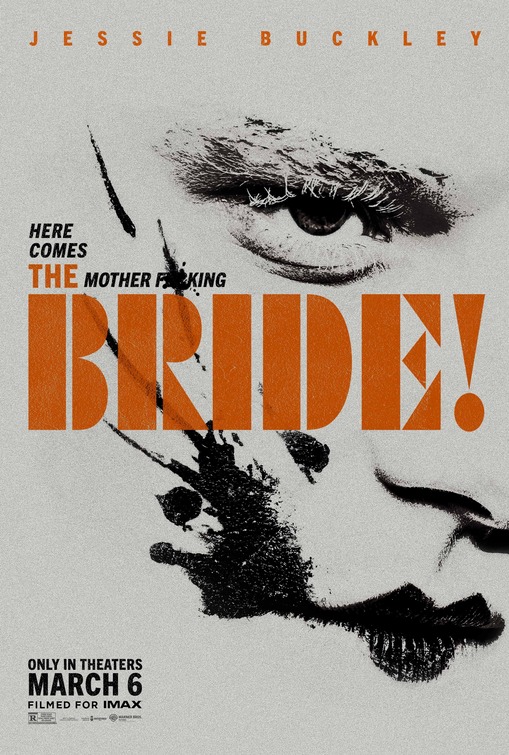
This ending was messy, bland, and failed to properly provide closure for many questions the audience were presented throughout the film, taking way too much time to exposition dump about Dr. Euphronia’s past – a character who hadn’t been present since the very beginning of the movie. The mob is clearly present in the movie, but doesn’t do anything beyond being used as a plot device to explain the Bride’s past, and there is no time spent on exploring them at all. Myrna is a fantastic detective, but her character’s ending doesn’t make any sense – Jack had no authority to give her the title, and it certainly wouldn’t give her power over the captain of the police.
Not only that, but the complete lack of respect for the Bride as an individual after Frank dies was a huge letdown. She immediately loses all independence and says that she needs Frank to survive, despite previously declaring herself a separate person after the revelation that he had been taking advantage of her, both physically and mentally. To have her decide to have him revived in the next scene after this revelation completely undermines her character’s growth and the feminist themes that are being pushed throughout the movie.
She even explains to Dr. Euphronia that she needs him, and is nothing without him. Not to mention the shot of her dead body falling atop his, as if they are one in death. The story clearly prioritized pushing this as a romance rather than giving the female character any autonomy or growth – it would have served her arc much better to have Frank killed off much earlier in the film, allowing the Bride to live life on her own, maybe even leading the Violent Femme’s and/or directly interacting with Myrna.
The Focus on Male Perspective and Assault as a Plot Device
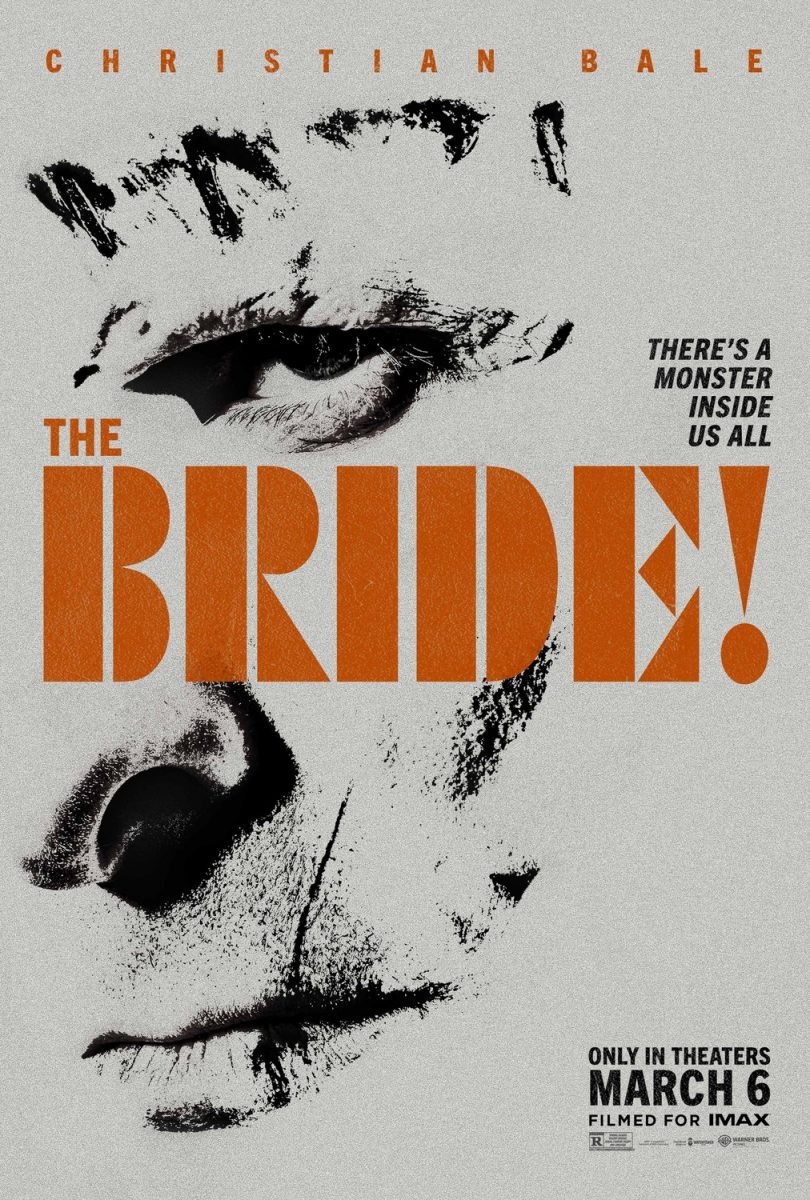
Because the Bride didn’t have her memory, the whole movie was focused on Franke and his wants and interests. For example, he loves old movies, so they are constantly watching them – it’s mentioned about a dozen times in the movie, and is used as part of the film’s exploration on his loneliness and want for a relationship that parallels those movies. Now, this makes sense as a metaphor for misogyny and how the traditional idea of marriage dehumanizes women to just be what their husband wants. However, when paired with the ending, where the Bride claims she can’t live without him, the movie doesn’t exactly show us that the two are bucking stereotypes.
The film was touted as a feminist masterpiece, and while there were clear elements that were meant to show this, such as the Violent Femmes movement, allowing the Bride to be sexual without degrading her, and Mary Shelley’s constant comments, the film seems confused about how to deliver this message as a whole. Trying to balance a gothic codependent romance while also showing women can be strong and independent seems to be the movie’s objective but, by having Jack give Myrna her detective status, and having Frank be the Bride’s constant driving force makes the men the power, undermining any feminine independence for these characters.
There was also a constant theme of sexual assault throughout – which is not a problem, when it is done well. Instead, we get multiple depictions of it for seemingly no reason other than shock factor and to keep with the idea of feminist justice. The themes don’t tie in to the conclusion and, other than killing the initial assaulters after it happens, there is no real message behind their inclusion.
In contrast to the direct assaults multiple men make on the Bride, there are also moments when men use their positions or their victim’s lack of knowledge to sexually take advantage of them. Instances include when Frank tells the Bride that she is his wife when she loses her memory, and the Detective taking advantage of the women undercover in the mob. Frank lies to Ida, telling her that they were together before her accident, and then he sleeps with her, essentially raping her.. To have her essentially take him back and forgive him after he dies without ever confronting this issue is offputting, especially when this movie is so keen to kill attempted rapists.
Another contradicting moment is Jack Wiles’ final monologue, where he reveals the sideplot about the mob, and how it connects to the Bride. In his speech, he details that there were undercover prostitutes who had enough information to take the organization down, but then the operation was shut down and the mob boss started killing them, cutting their tongues out. Jack talks about how, when the operation was shut down, one of the prostitutes came to him asking him to open the case back up. Jack slept with her, leading her under the assumption that he would open the case back up, despite knowing that he couldn’t. After this, he apologizes to Myrna and resigns, and we never see him again.
It’s this completely flat way of showing how even seemingly good men can be complicit in harming women that drags the plot and harms the feminist themes of the film rather than helping them, as they just throw that information at the viewers instead of using it as an underlying element. But, when it comes to his ending, it’s left ambiguous whether he is forgiven, completely abandoning the arc of a character who was a central part of the story and is just suddenly gone.
Having both of the ‘good’ male characters in this film take advantage of women and be forgiven while the explicit assaulters are violently murdered gives a conflicting message to the audience. It seems to say that all men are bad, and the kind of good ones should be forgiven and held onto even if they sort of rape someone, because that’s better than a violent assault. With sexual assault playing such a huge part in this movie it’s not just bad writing when they don’t explore those themes further, it’s turns that behavior into something that is acceptable. The feminist message becomes performative and hypocritical.
Conclusion
There was so much potential in this movie, blending 1920’s era stylism with fantasy and campy gothic mystery combined with punk inspirations. The cinematography is intriguing and eyecatching, and the costumes and makeup are stunning. The introduction scene was phenomenal, leaving me prepared for an intense and beautiful film and the Violent Femmes were also a really cool inclusion that I wish was explored more.
With the short appearance of the Bride in the original 1935 film The Bride Of Frankenstein, this movie was meant to explore her character more fully, but instead got caught up on Frank and too many side-plots. The mob was an interesting part of the movie, and it would have been amazing to see The Bride take them down, especially since she was originally murdered by them. Instead, there was a lackluster ending for that sidelined part of the story.
Overall, I was never bored watching this movie and, if you view all the parts separately, the costumes, the sideplots, the characters, all make up a fantastic and interesting film – barring the juxtaposition between feminism with male-centrism and the way it treated assault. However, the way these elements combined was ill thought out, like it was created by a mad scientist stitching together mismatching limbs and organs together in the dark to create a monstrous disaster. Maybe that was on purpose, but it makes for a rough viewing experience…