By Draven Copeland, Managing Editor
Having seen nearly 2,000 films in my lifetime, I’ve seen many different takes on how a director likes to create the moviegoing experience for their audiences. From cinematography choices like Coralie Fargeat’s horror-inspired camerawork to stylistic presentations like Quentin Tarantino’s classic opening credits sequences, most high-quality filmmakers have a certain style that sets them apart. However, in all of my movie-watching experience, I have never seen a director with a filmography such as Gaspar Noé’s.
I’ll come right out and say it: I’m biased here, as Noé is my favorite filmmaker of all time. I fell in love with his style and philosophy ever since I first saw his 2018 film Climax, which completely blew my mind because of his take on the New French Extremity movement of filmmaking. What sets him apart is the fact that, despite the extreme content of his films (as is the norm in the movement), Noé has never sacrificed the artistic nuance he uses in his cinematography and storytelling. I’ve always felt as though my perspective on life has been improved because of his films – maybe I just need to see the brutality of humanity to truly appreciate the good in the world, or maybe I just really like movies that scare/disgust me… if I’m honest, I think it’s a bit of both.
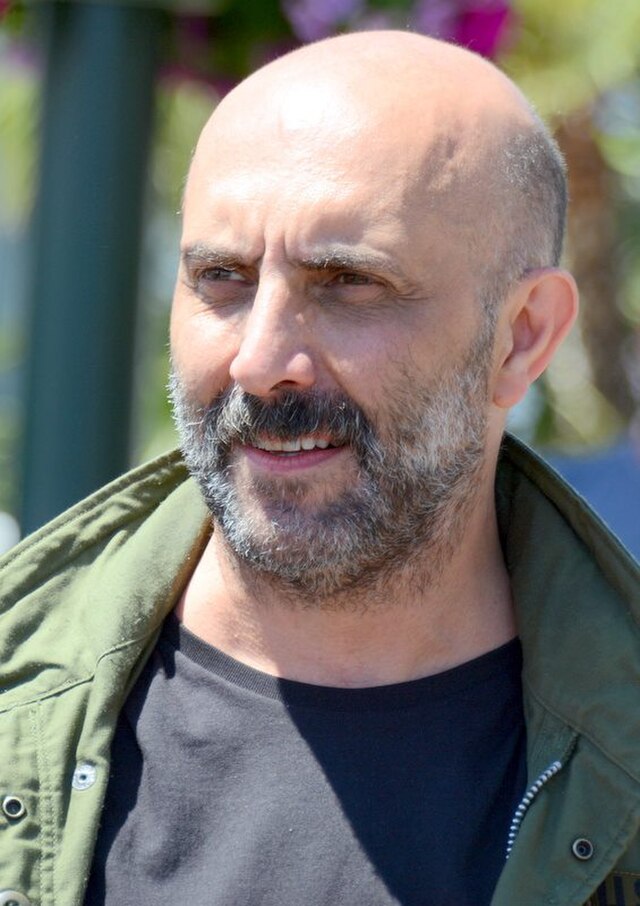
In fact, Noé’s work has been the greatest inspiration in my own creative work, especially his mastery of evoking emotion in his audience – even though most of these emotions are negative. It’s impressive to me how consistently he is able to craft new and unique stories that elicit emotions and thoughts that I never considered the same way before seeing his work. I’m especially impressed by his use of transgressive content with purpose instead of for the sole sake of shock factor, utilizing the way these extreme sequences affect the audience to help his intention rather than hinder it or detract from the artistic integrity of the films.
So join me as I go through his filmography and talk about the basic plot, what I liked, what I didn’t like, and how watching the films affected me personally. As I alluded to earlier, Noé’s films are very philosophical, based largely around his atheistic perception of reality and obsession with the dark side of human nature. Nearly none of his protagonists are completely morally sound (especially the male ones), as they are generally used as a vehicle for criticism of the negative choices people make and how their consequences affect both the individual and those around them.
As Noé is an acclaimed contributor to the New French Extremity movement, a subgenre of filmmaking that arose in the 2000s that focused largely on creating purposefully extreme/transgressive films, he covers very harsh topics that I will be discussing only in the context of the film’s plots. While these themes will all be discussed in a fictional context, I’ll still warn that this analysis will get pretty dark. Topics may include, but are not limited to: suicide, sexual assault, drug abuse, death, mental illness, and more… If any of these topics bother you, please feel free to skip my discussions of the films that feature them – I’ll put a content warning before each section so you know what you’re getting into.
One last thing before I get into it: part of what inspired me to write about Noé is the fact that a few of his films are free to all Pellissippi State Community College students, available on Kanopy, which is free to sign up for with your school email! I’d thought that Noé might’ve been too niche, but hey, you won’t catch me complaining. For this first part, I’ll be covering his work in the New French Extremity movement, and next week I’ll cover his transition into meta-art and slow cinema – those will be a little more lighthearted, I promise.
I Stand Alone (1998) [original title: Seul contre tous – literal translation: Alone Against Everyone]
(Harsh topics include incest, suicide, and racism/homophobia)
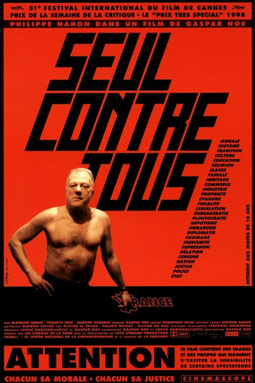
Noé’s first film is actually a sequel to his short film Carne (French for “Flesh”), which explored the life of a rural horse butcher who loses everything in his life after the birth of his mute daughter, for whom he is clearly battling incestuous thoughts. In the short film, he loses his wife, job, and societal standing, ending up stuck in a relationship with his boss whom he got pregnant, and completely estranged from his daughter.
I Stand Alone continues the story of the unnamed butcher, exploring his history of enduring abuse and tragedy as a child, further expanding upon the tragic life he led in the short film. Throughout the film, the majority of the spoken word is the butcher’s internal monologue, as the viewer follows his thoughts that become increasingly unhinged while his life continues to fall apart.
In the end, his thoughts become nearly incoherent rambles, blaming everyone around him for his situation. These thoughts lead to anti-establishment conspiracy, racism/homophobia directed towards his fellow commoners (which is especially interesting considering his past relationship with a man while he was imprisoned), continued incestuous thoughts about his daughter, and, finally, murderous/suicidal ideation.
Whew, okay, so now that the basic plot is out of the way, let’s talk about what I liked about the film. Firstly, let me say that this is certainly Noé’s most amateurish feature film – which is understandable considering it’s his first. A lot of his later directorial style is introduced here, most importantly, his use of title cards to speak directly to the audience.
Words like “Morality” and “Justice” display on the screen as title cards at different points in the film, leading the audience to think about what those words mean in the context of the plot, as both of them are increasingly misunderstood and misused by the butcher throughout the story. Finally, a content warning with a 30-second countdown is displayed before the ending, in which the butcher gives in to all of his intrusive thoughts. While these events are quickly shown to just be a fantasy in his mind, the film ends by showing that the butcher is living right on the edge of completely spiraling out of control; the final scene is meant to show that the butcher’s breaking point could be broken through at literally any moment.
What makes this film so strong is its completely unfiltered vision of the evils of man. I Stand Alone explores how trauma and tragedy combine with negative and self-serving thoughts to lead into decisions that then craft a warped sense of morality and justice, eventually ending in more tragedy. It’s important to understand that, in every moment of the film (and its prequel short film), the butcher’s perspective is his downfall – looking at every challenge as a reason to spiral instead of a reason to move forward and grow leads him into the emotional/mental degradation he experiences.
What I didn’t like about this film was really just how incredibly dark and depressing it is. Sure, that’s Noé’s style, and I love him for that, but here and in the preluding short film, it very closely rides the line of going too far with it – it’s almost an assault on the viewer just to watch, which I’ll go further into with the next film. While I like it as an exercise in style and commentary on the lives of the poor in a world separated by class, as well as trauma and the cycle of violence, it’s very rough to get through and, in my opinion, has the least artistic justification of Noé’s films.
The part of I Stand Alone that really moved me was the fact that I could see how the butcher chose to approach his life; yes, he goes through tragedy at pretty much every turn, but it’s how he perceives the obstacles that lead him to further despair. He could’ve chosen optimism, could’ve directed his anger towards those who were truly responsible for his situation, could’ve made a better life for himself, but he chooses not to. The line between unavoidable and self-inflicted tragedy is clear in this film, while Noé comments on how difficult it can be to see that line as a struggling lower-class man.
Irréversible (2002)
(Harsh topics include sexual assault and murder)
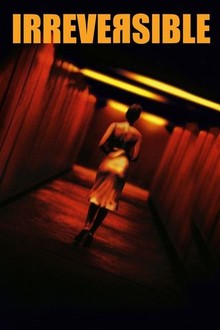
Considered one of the most controversial films of all time, and for good reason, Irréversible is a stark and confrontational depiction of sexual violence and its effects on victims and their loved ones. Told in reverse chronological order – meaning that every scene in the film is followed by a scene that takes place directly before it – the story revolves primarily around a man and his search for revenge after his girlfriend is brutally assaulted and left for dead. While I consider this film to be a masterpiece in extreme cinema, it is 1,000% not for everyone; I would not recommend this film to anyone who isn’t interested in French Extremity or Noé’s work in general.
Similar to his first film, Noé explores the toxic masculine urge for violent vengeance that overrides one’s love and care for the victim of violence. In the boyfriend’s search for revenge, he acts aggressively even towards those who help him find the man that he eventually kills in a fit of rage – who is later revealed at the end of the film to have been the wrong guy. Instead of staying with his girlfriend as she is shuttled to the hospital, he instead roams the streets in violent pursuit that ends in tragedy and imprisonment, leaving him to wonder whether she has lived or died.
What I love about Irréversible is the format in which the story is told. We see violent vengeance in the beginning, setting up the added heartbreak of the graphic assault scene later on, when it is revealed that the unknown perpetrator has actually gotten away and the wrong man is later violently killed. Similarly, we see the boyfriend’s violent search for vengeance out of context, as it is unclear to the viewer why he is so violent until we finally see the reason why; this helps to show how little violence accomplishes, as we are left to wonder what could’ve compelled such extreme aggression.
After seeing the assault scene, we then realize even further how pointless the boyfriend’s rampage was, as that path was taken instead of staying with the person he professes to love and care for, and his decision eventually ends in the misdirected murder of a seemingly innocent person. Then, in the final scenes, we see the two living as normal, loving partners, emphasizing the horror that they don’t know will soon befall them. Seeing them happily enjoying life and each other’s company becomes an ominous and heartbreaking moment, and seals the thematic purpose of the film: that the unfortunate reality of sexual assault is an irreversible tragedy that devastates the lives of the victims and those close to them, while the perpetrator often walks free.
There is very little I didn’t appreciate about this movie, which feels horrible to say, considering the highly controversial, near-10-minute graphic scene of assault. It’s quite honestly one of the hardest things I’ve had to watch in my entire life, and it has kept me from rewatching it even just a second time, but I do see the value in forcing the viewer through the experience with the character in the film, emphasizing the fact that she can’t escape and, therefore, neither can we. I feel like this topic is something that is often shied away from being shown in film – and for very good reason – but I think that it is done here in such a way that it assists the purpose of the art more than hinders it. This sort of thing should be a horrifying thing to see as a viewer, and I feel like this film understands that more than most others in the rape-revenge genre, such as the hugely popular The Last House on the Left and I Spit on Your Grave films.
One thing that this film gets a bad rap for is the fact that the victim in the story is not very fleshed out beyond being the girlfriend of the primary character of the film, and is used more as an object for violence than a character of her own. This criticism is incredibly valid. However, I will argue that, in her relatively little screen time, she is a strong character, confronting her boyfriend for his behavior at the party that she leaves early before tragedy strikes and contradicting him many times when he does or says something she doesn’t agree with. Certainly, this is little consolation considering what befalls her, but I also think that the purpose of the film was to criticize male behavior both in the tragic event and following it, which leads me to overlook her relatively small part in the film. Nonetheless, I can’t hate on anyone who takes this stance of criticism – it’s not unfair in any way.
What moved me about Irréversible was its very real understanding of violence; from its ultimately purposeless beginnings to its irreversible ends, there is no reason for it. Even the act of continuing the cycle of senseless violence in revenge for its effects on a loved one doesn’t solve the problem but merely amplifies it. One horrific act only leads to another, and another, and so on, until every character but the original perpetrator ends up for the worse. Seeing this topic so expertly conveyed, not despite its extremity but because of it, is truly what sets Noé apart from other filmmakers.
Enter the Void (2009)
(Harsh topics include drug abuse and death)
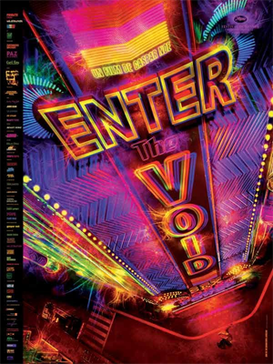
After the horrible topics of the previous two films, death and the afterlife feel relatively not so bad of topics to explore. In Enter the Void, Noé’s first primarily English-language film, the story is told completely through the first-person perspective of a man who takes hallucinogens and then is killed by police officers in a botched raid shortly after. We hear his inner thoughts as he passes into the afterlife, which is then portrayed from the perspective of his spirit as he wanders throughout the city of Tokyo, watching over his sister in the present/future as she deals with the news of his death, intercut with past memories of his from when he was alive.
Combining the hallucinogenic imagery of the man’s high with the out-of-body experience of death and, eventually, reincarnation, Noé delivers a sort of film that I really haven’t seen before or since. In his examination of death, we are shown life in all its ups and downs, as we float along with the character’s fracturing consciousness through time and space, looking at the minutiae of the human experience from a physically detached, but emotionally resonant, point of view.
What I love about this film is its intentional storytelling among the long, seemingly pointless shots that are mostly just allowing us to witness the world from another perspective, usually that of an overhead view. Examining time as non-linear, the spirit and mind as supportive but separate beings, and the bond between loved ones as the only lasting connection after death, are all deeply thought out in this film, bringing a sense of spirituality to atheistic storytelling that is truly very unique. Combining all of these things with the CGI visuals of a hallucinogenic trip is honestly genius, as the line between reality and unreality is toyed with in the early scenes before being completely broken open after the character is killed.
What I don’t like about this film is that it is long and a slow burn for sure. At two and a half hours, it’s Noé’s longest work – even longer than his slow-cinema film, Vortex – and the novelty can grow faint very quickly depending on how invested in it you might be. Even I, who love all his films to death (no pun intended), can find myself getting a little bored at times, and am honestly glad when the whole ordeal finally comes to a close, as the man is possibly reincarnated? It’s left up to interpretation whether he restarts his life or begins a new one, and either is equally interesting to me, as the implication of the former is that of predetermined destiny and the implication of the latter is that of the perseverance of the spirit.
What moved me in Enter the Void was the very blunt, realistic portrayal of life and death, even despite the fantastical hovering and traveling through time. Here, the fantasy helps accentuate the reality, and it’s really intriguing to me how that is done without ever feeling silly or out of place. Instead of analyzing violence and its effects on the living, here we see it from the perspective of the dead, unbound from any sense of justice or retribution, as our only focus is to hope in the possibility of something better at the end of the ride. It made me look at life from a different perspective, and even changed some of my ideology about death and what might come after. For a movie to do that is impressive in and of itself.
Love (2015)
(Harsh topics include sexual content and drug abuse)
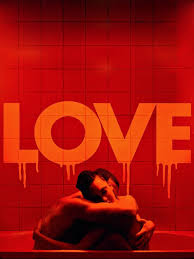
Noé returns after a six-year hiatus with his second English-language film, Love, a very blunt and graphic depiction of every aspect of a romantic relationship that quickly falls apart in one of the worst ways possible. Told out of chronological order like the last two films, the plot follows Murphy as he falls in love with Electra, progressively falls out of physical satisfaction with her, and then accidentally impregnates their apartment neighbor after the couple agrees to have a threesome with her to strengthen their relationship and live out their respective fantasies. The true meaning of love is questioned throughout the film, as Murphy consistently misunderstands the line between love and lust and the long-term consequences of actions taken while in a relationship.
Similar to his first two films, the main male character is once again a vehicle for criticizing men in modern culture, as his primary drive throughout the film is his sexual desire, leading him to ruin his relationship with the woman he truly does love and the dreams of his future through the unexpected birth of his child. Electra’s life is altered too, as she falls back into her past habit of drug abuse, which eventually leads to her death.
What I liked about this one was also what I didn’t like: the graphic, unsimulated depiction of sex. On the one hand, I respected the fact that this side of a healthy relationship between consenting adults was fully shown and explored onscreen, as the scenes are more than run-of-the-mill pornography and instead contribute to the narrative by means of exploring the personalities and behaviors of the people involved. As with any scene Noé has filmed, the sex scenes in the film are artistically choreographed and shot, and generally add to the plot/theme of the film instead of taking away.
However, what I didn’t like was that there are so many of these scenes, and they are indeed very graphic. While I still loved Love, the repetition of these scenes was so exhausting to watch that the artistic weight of the film didn’t fully hit me until the next day, when I actually took the time to think it over. While this is not an unpopular opinion – in fact, the most criticized point of this film is the graphic sex – it also led to the film’s popularity on Netflix during the COVID-19 pandemic, even culminating into a trend in which viewers recorded their reaction to the opening scene, which is, of course, one of the most graphic sequences in the film.
What moved me most about Love was its all-encompassing portrayal of a doomed relationship and the ups and downs of both emotional and physical connection. Love it or hate it, I will say that the film explores its topic more extensively than I have ever seen from any other movie I’ve watched, and does an incredible job of criticizing contemporary love life in a very modern way, utilizing the growing availability/popularity of pornography to tell a deep and philosophical tale about the real consequences that come with love and its misapplication.
As each character understands the meaning of “love” differently, their connection is strained and eventually broken; even though they do truly love one another, it’s this misunderstanding of what that means that is their eventual downfall. While the plot of the film is an extreme example, I think this is something anyone who has been in a doomed relationship can relate to to some degree – two people can love one another perfectly fine, it’s just particularly hard to find someone who understands what love means to you, and vice versa. Especially in the age of modern dating, Love feels especially poignant, even if it becomes self-indulgent along the way.
Conclusion, For Now
What impresses me most about Noé’s contribution to the New French Extremity movement is his use of extreme content combined with unique cinematic language to convey philosophy, often minimizing dialogue and using visuals to carry the thematic message. Using the human experience as a baseline for emotional affectation, especially to induce feelings of anxiety and horror, is extremely effective in his work because everything you see is grounded in reality instead of relying on exaggeration or fantastical creatures to scare the audience.
Next week, I’ll be covering his final three films, as he transitions from New French Extremity filmmaking to the slow-cinema genre. These upcoming films will be far less emotionally affronting, as he begins to rely less on shocking content and more on the strength of the topics themselves. I don’t think any of these upcoming films are necessarily more or less artistically strong, but they are more palatable for wider audiences, making for more easily recommendable movie nights. While I love all of the movies I’ve talked about so far, I will say that I still find them incredibly hard to recommend; whether you end up giving one a try, waiting for next week’s discussion of his later films, or just taking this article as the most you’re willing to dip into Noé’s filmography, I appreciate you taking this ride with me. Join me next week for a dive into his most recent films, Climax, Lux Æterna, and Vortex!