
By Patrick Dobyns, Opinion Editor
That’s right, everyone! After over a millennium of searching, one of Christianity’s holiest relics has finally been found. The Cup that Jesus of Nazareth reportedly drank from during the Last Supper, often referred to as the Holy Grail, has been positively identified by scientists and theologians, having been uncovered in Wartburg, TN, on 25 March 2026. Pope Leo CLIX has declared a week of celebration across the Catholic world, while Protestant Churches across the country have declared its discovery a sign of the Second Coming.

The so-called “Cup of Christ” has great historical significance. It was used by Jesus of Nazareth during the last supper and used by Joseph of Arimathea to catch the blood spilled during his crucifixion. It was during this event that the relic is said to have gained its ability to grant mystical boons to whoever drinks from it. Among the reported effects are immortality, guaranteed entrance into Heaven, the ability to turn water into wine, the ability to turn wine into blood, the ability to turn blood into wine, the ability to turn water into blood, lactose tolerance, laser eyes, and speaking Esperanto. The Grail gained more widespread fame during the medieval period in Britain, where the legendary King Arthur sent knights out from Camelot to quest for the relic to varying degrees of success. The veracity of these particular stories is under some scrutiny, due to the fact that knights had not yet entered into Europe’s society, and the questionable existence of Arthur or anyone else in those stories.

The discovery came when Wartburg resident Wallace Williams brought a chalice to a pawn shop, looking for a replacement for his “favorite drinking mug.” The owner of the shop, Kurt Harlan, initially gave him $3.15, but later became clued into the nature of the artifact when an engraving in an unknown script caught his attention. The inscription was an ancient form of Syriac and reads “Made in Babylon.” In addition, when drinking from the chalice, it was observed that none of the archaeologists on site aged into dust.
When asked about where he obtained the artifact, Wallace said, “Well I just won a fishing tournament and the folks gave me a ribbon, then this guy came outta nowhere and gave me this cup, which I thought was kinda queer since I already won a ribbon and the cup didn’t look like the regular kind of trophy you usually get, but I took it anyway and used it cause I didn’t see no sense in throwing away a perfectly good cup, so for the past twenty or so years I been drinking my beer outta it, and it seemed good enough for that then, but now I’m starting to think it might have been kinda blasphemous…” However, officials from the 2003 Norris Lake Fishing Tournament denied having given out any trophies that year.
Kurt Harlan owns the Lone Mountain Mega Pawn, a few miles outside of Wartburg, and came into possession of the artifact after Wallace sold it. After finding the inscription, he asked a friend who worked at the University of Tennessee (who has requested anonymity) to translate it. A scan of the Grail made the rounds throughout the campus, and after a matter of a few weeks, it became apparent that the cup was indeed the Holy Chalice of legend. While Kurt has allowed various academics to study the artifact, he has not relinquished possession of the Grail. When asked what it would take for him to sell or donate it, he jabbed back, “I’ll give it up when someone can give me my damn legs back.” (It should be noted that Kurt is bound to a wheelchair due to a spinal injury.) As of March 31, at least three professors at UTK have gone on record saying, “It belongs in a museum.”
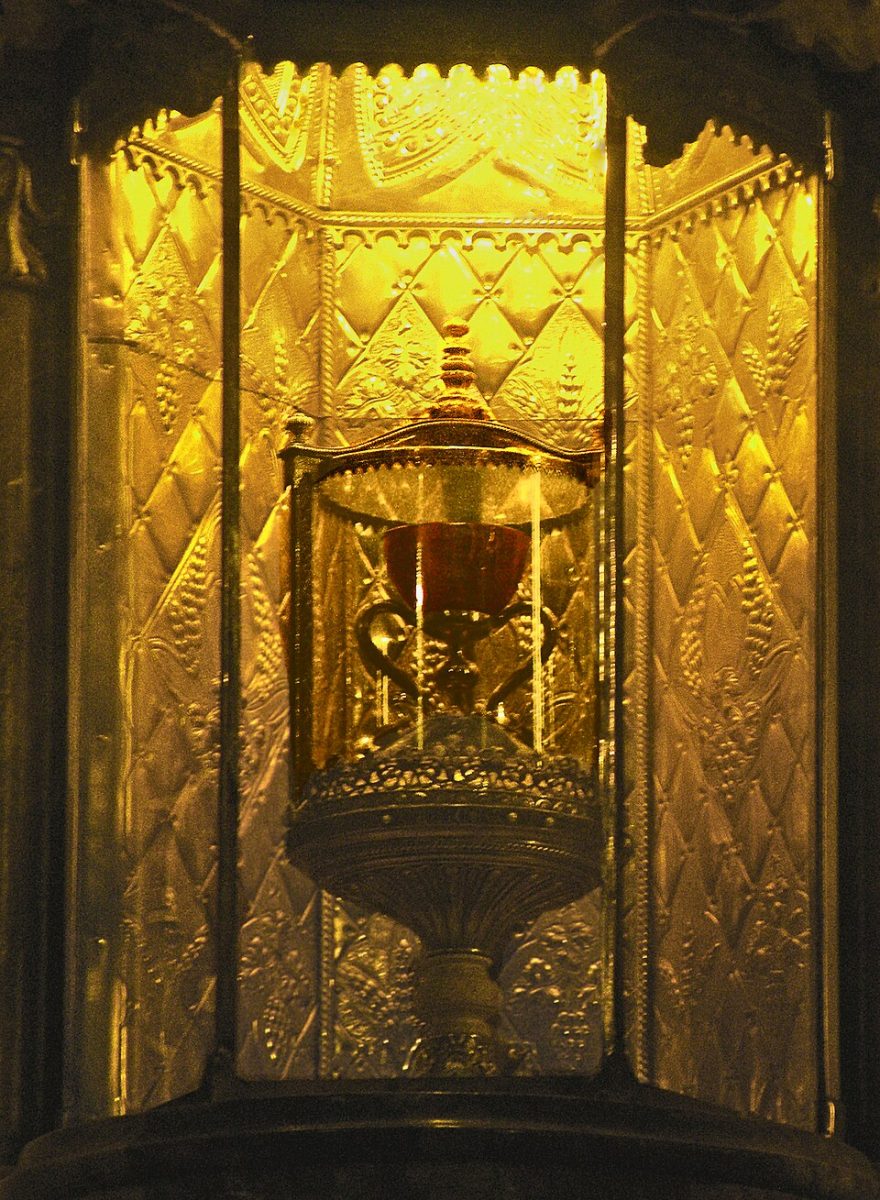
There are, of course, other artifacts whose holders claim them to be the original Holy Chalice, such as the Nanteos Cup in Rhydyfelin, Wales, the Antioch Chalice held by the Metropolitan Museum of Art in New York City, the Grail of Pythos kept in the Castle Aaarrrgghh in Scotland, and the Valencia Chalice in the Cathedral of Valencia, Spain. The keepers of these much more impressive relics have ardently denied the veracity of the claims of what is being called the Wartburg Beer Mug and have made petitions to the Vatican to rescind the celebration he has declared and denounce the relic as false. French scholar Jean Cleise had this to say of Kurt: “He is an empty-headed animal food trough wiper! I fart in his general direction!” The Pope has not yet given a response to the outrage.
While studies are still underway, there are a few facts we know for certain at this time. The chalice has been confirmed to be around two thousand years old, give or take fifty years; the material can be traced to modern-day Iraq from that era; the inscription on the base is in ancient Aramaic, the same language used in first-century Judea; and theologians are claiming it to be just as valid as any other claim. The question still remains of how it managed to find its way to rural Tennessee. One hypothesis put forward is that a Roman trading vessel was blown wildly off course, depositing its cargo (with the Holy Grail) on the shores of the Americas. Another is that a secret operation of the Knights Templar found and recovered the artifact, sailing as far West as possible to keep it out of the hands of the unworthy. Perhaps the most popular theory is that of simple migration, saying that a European Swallow may have clutched onto it and carried it across the Atlantic. One thing is certain in all of this: those who have found themselves excited over this discovery may have forgotten what today is. Happy April Fools!
Fact Check from the Author!
As some of you may have figured out before the end, this is definitely a fictional story. That does not mean that everything in here was entirely made up, though. There are several pieces of real-world lore and trivia scattered throughout, as well as references to popular media. Fans of Indiana Jones will have easily caught the mention of archaeologists turning to dust as evidence of the Grail’s authenticity, referencing the scene in Indiana Jones and the Last Crusade (1989) where, when presented with a room full of chalices that could potentially be the Grail, choosing the wrong one turned the Nazi conspirator into a pile of dust. Of course, the other reference to the franchise is when several professors declared the Chalice “belongs in a museum–” a classic Indie catchphrase.
Other references come from Monty Python and the Holy Grail (1975), a British comedy about King Arthur and his knights. The “Grail of Pythos” is a play on the group’s name, while the Castle Aaarrrgghh is where the King and his knights ultimately find the Grail, before being arrested for the murder of a modern historian. The French scholar Jean Cleise is based on an actor in the film named John Cleese, among his roles was a rude French soldier who continuously insulted Arthur, saying, “I don’t want to talk to you no more, you empty-headed animal food trough wiper! I fart in your general direction! Your mother was a hamster, and your father smelt of elderberries!” The theory proposed in the last paragraph that a European Swallow carried the Grail to the Americas by clutching at it with its talons also comes from this film, where a character questions how a coconut got to Britain, and is incredulous when Arthur says a Swallow might have carried it.
Lastly, bits of actual Arthurian myth were scattered throughout the story. Before Arthur’s knights can obtain the Grail, it’s said to be held by the Fisher King, who is impaired to such a degree that he can no longer walk nor ride a horse. In many myths, he only gives out the grail to those who can heal his injury. This is reflected when Wallace Williams wins the fishing tournament (thus becoming the Fisher King), and when Kurt Harlan refuses to part with the Grail until someone can give him back his legs.
The other Grail claimants mentioned in the story are indeed real artifacts whose owners claim they might be the Holy Chalice (aside from the previously mentioned Monty Python reference). The Valencia Chalice is one of the oldest claimants, dating back to thirteenth century Spain, and is considered a holy artifact by the Catholic Church. The Antioch Chalice was discovered in 1910, and dating of the relic puts its manufacture within the first century AD; this, along with its recovery alongside several other Christian artifacts, led it to be displayed as the Holy Chalice at the 1933 Chicago World’s Fair, although recent hypotheses suggest it’s actually an oil lamp. The Nanteos Cup in Wales perhaps fits the description provided in the Indiana Jones film– “this is the cup of a carpenter.” It is a mostly broken wooden bowl that is reported to have healing abilities and is rumored to be carved from the True Cross. Dating, however, puts it between the fourteenth and fifteenth centuries, so it is an unlikely candidate.I hope everyone has a happy April Fool’s Day today! I had a lot of fun writing this, and I hope it made some of you laugh. Just remember–trust nothing you hear today!