
- Gaspar Noé Career Retrospective, Part I: The New French Extremity
- Gaspar Noé Career Retrospective, Part II: Transition into Slow Cinema
By Draven Copeland, Managing Editor
After covering Noé’s work in the New French Extremity movement last week, this next section of his work will definitely be more palatable for general audiences, at least in the sense of graphic content. As he transitions from extreme cinema to meta-art and slow cinema, he moves towards the use of subtext and underlying themes to affect the audience as opposed to the very confrontational and purposefully transgressive style he used in his earlier films. It’s a shift that I really appreciate, especially because I feel a lot more comfortable rewatching and recommending these films – that’s not to say that he has entirely changed, since the content still remains very intense and focused on the darker side of the human experience.
Just like in the first part, I’ll be discussing each film’s basic content, what I liked about it, what I didn’t like, and how each one impacted me… as I said in the previous entry, Noé’s work is some of the most transcendent examples of art that truly move me every single time. After watching each film of his, I’ve felt like I’ve been forced to consider aspects of life and my own interpretation of it that I hadn’t before, and if that’s not the purpose of art, I don’t know what is.
While the content of these films is less transgressive and extreme (all of these films are rated R or below, as opposed to the NC-17/Unrated stature of the films in my previous entry), they still contain some potentially emotionally harmful content, so I will once again be giving content warnings for my discussion of each film. Like last time, everything I’ll be talking about is only as far as it is used to discuss the films, and all of these films are fictional, but feel more than free to skip over the discussion of a film if it has content that might bother you; it’s completely understandable.
Climax (2018)
(Harsh topics include drug abuse)
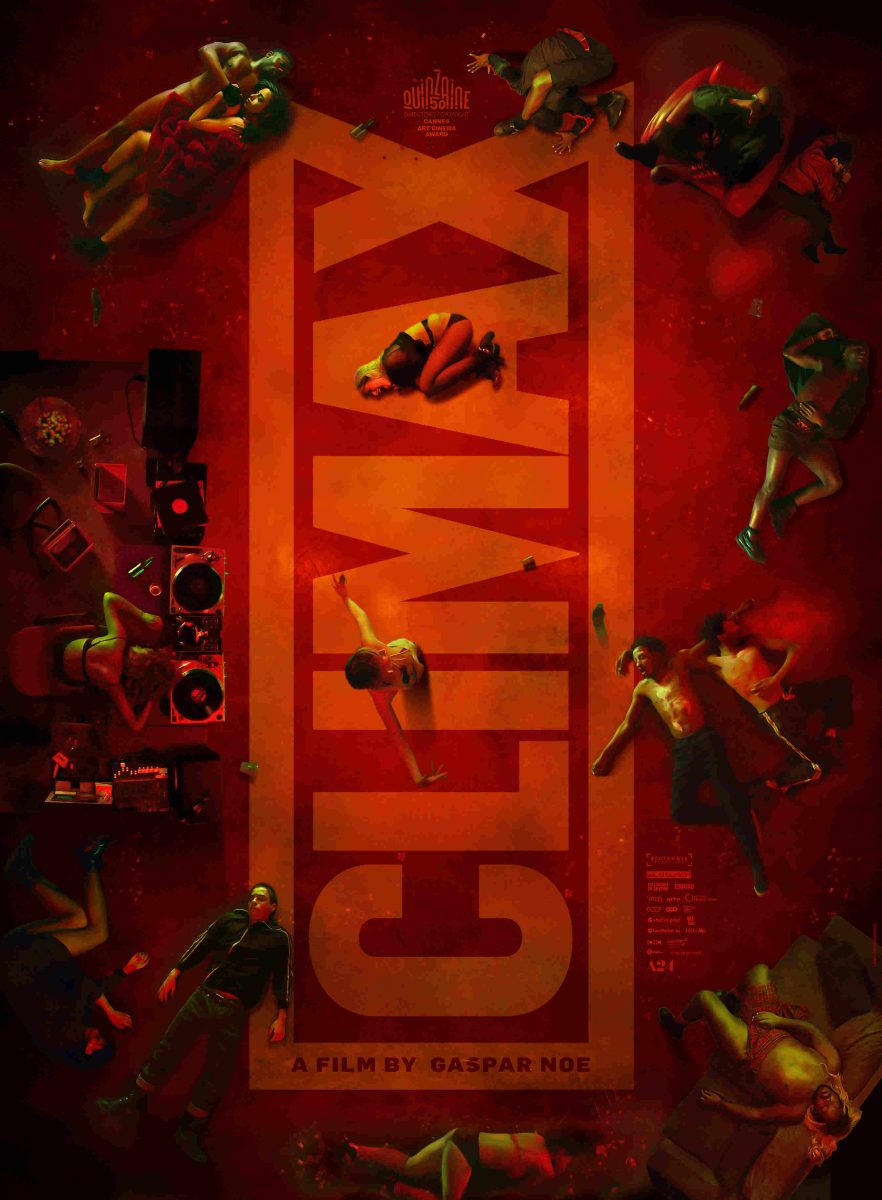
The first Noé film I ever saw, Climax is a rapid descent into the inner evils that lie underneath our outward composure. The first of Noé’s films to be told in chronological order since I Stand Alone, the film follows a dance troupe celebrating their first rehearsal in an abandoned school during a snowstorm. After it’s quickly realized that someone had laced the party punch with LSD, the party devolves into a violent and terrifying dive into the dark side of the human experience that is somewhat reminiscent of a combination of The Lord of the Flies and Dante’s Inferno.
With only a five-page script, the plot is fairly simple, broken up into five unique sequences with a brief epilogue. Because practically no dialogue was written and the film heavily relies on it in the early sections, nearly all of the lines are improvised, creating very realistic character interactions that feel genuine, unburdened by memorized back-and-forths. Similarly to found footage films like Paranormal Activity and The Blair Witch Project, not only was dialogue heavily improvised, but it’s delivered by a cast of almost entirely unknown/unprofessional actors. Every dancer in the film is a professional dancer in real life, with Sofia Boutella the only actress on set with professional acting experience.
This may seem like a hell of a gamble, but it works out in Noé’s favor, as it helps the viewer feel grounded in what seems like genuine reality instead of a superficially constructed one for the sake of plot development. Noé still doesn’t sacrifice narrative depth, however, as this film heavily employs cinematography to tell the story, similarly to how Enter the Void used the camera to play the main character’s spirit. With multiple long-shot sequences, including one that’s over 42 minutes long, the viewer experiences the rampant anxiety and terror that ensues throughout Climax after the troupe begins to have a bad trip with no chance of escape.
What I love about this film is how simultaneously simple and complex it is. On the surface, it’s just watching a group of dancers get interviewed, do their routines, talk to one another, and then trip out, and the film works fine that way, with the title referring to the intensity of the final sequence. However, if you dive deeper into the purpose of each sequence, the film is a slow deconstruction of who a person truly is; first, we see the dancers respond to interview questions, presenting their best selves. Then, we see them dance altogether, emphasizing the way they physically express themselves in a group, before we see them gossip about one another in small groups, showing the more casual side of their presentation. After that, we see a one-by-one dance-off as they unknowingly begin to be affected by the hallucinogen before they spiral completely out of control, with only their most basic intentions and primal instincts remaining.
This is another film I have trouble finding things not to like, but if I had to choose, I would say that the movie is fairly uneventful and can sometimes border on boring until about two-thirds through. I still think that every scene and line of dialogue has plenty of opportunity for analysis and conceptual deconstruction, but it does drag, especially if you’re coming solely for the entertainment factor.
What really moved me about this film was its deconstruction of the psyche, as the layers of the dancers’ personalities progressively fall away until they only act on their most intrinsic desires. As opposed to films like 2001: A Space Odyssey (a favorite of Noé’s), in which the evolution of intellectualism is shown in forward motion, Climax moves backwards, portraying the superego descending back to the id, serving as a stark reminder of what lies beneath the calm composure of modern humanity. It’s also another very interesting use of drug abuse to explore philosophical topics, like as in Enter the Void, as the realistic negative effects of a bad trip strip away the characters’ humanity as they, in the most basic terms, freak the fuck out.
Lux Æterna [literal translation: Eternal Light] (2019)
(Harsh topics include discussion of historical witch hunts and related misogyny)

Speaking of films not meant for their entertainment factor, we have Lux Æterna, Noé’s only feature-length essay film, clocking in at just 51 minutes in total. As it is a meta-artistic essay on filmmaking far more than it is a narrative story, there’s not a ton to deconstruct beyond the meaning of the conversations and the overall vibes throughout the very basic plot.
The movie begins with a collection of old film clips re-enacting witch hunts throughout history before we’re presented with the backstage production of a scene in which the lead actress is playing a witch who is being burnt at the stake along with two others. After things go wrong in pretty much every way possible, leading to intense arguments between the male producers and the female lead director, the actresses get on set for filming. Before they can even get a full rehearsal shot, there’s a malfunction with the backing lights, creating an epileptic multicolored strobe that the actresses are forced to endure because they are tied to the stage prop stake. During this commotion, the director’s chair is overtaken by her male assistant director, who enjoys the actresses’ suffering as it gives him the perfect performance for the shot that he wanted. And then the credits roll against the continuing strobe.
What I love about the film is its intensive exploration of misogyny and its many forms throughout time. The actresses and female lead director are constantly undermined, disrespected, harassed, and overridden by the male producers and assistant director, who eventually completely overtake the production and metaphorically incite the strobe malfunction at the end. This is compared to the attitude towards women during witch hunts and to the filmmaking process of other films based on the time period, as we are told through multiple title cards about the real suffering of women in these films; one of the most memorable ones told of an actress that was forced to stay up on a stake for full days of shooting without being let down between takes.
The framing of a film within a film about historical abuse of women being made by women and then overtaken by abusive men in power is such a great parable for the enduring misogyny in the world today. This is all coincided with an ongoing discussion about film’s creative purpose as art and not solely for entertainment, as the purpose of art is to move people in a way that’s akin to magic. Therefore, witchcraft is used for many purposes here, symbolizing the reliving of past trauma, spirituality in artistic creation, the magic of filmmaking, enduring feminine rage, and the immortalization of life in cinema.
What I don’t really like about Lux Æterna is the fact that it is the most concerned with art for art’s sake out of all of Noé’s films – which is really saying something considering his filmography. Instead of a film meant for entertainment, it’s a film meant as a visual essay on filmmaking and misogyny, which is amazing for its purpose but not really meant to sit back and enjoy. Thankfully, it’s not even an hour long, and never really overstays its welcome – I feel like it would’ve felt self-indulgent and overbearing if it were any longer, but it’s perfect as is.
What moved me about the film was its portrayal of suffering put to worth in the form of finished artwork, highlighting the horrors that artists have to go through to create their art. Especially in the context of such a collaborative effort as filmmaking is, the interpersonal disagreements and abuse of power feel very real and poignant to the story and its message, making the hellish experience grounded without relying on extreme content like Noé’s earlier work. After all, the experience of creation can be a horrible one, even despite the quality of the finished product.
Vortex (2021)
(Harsh topics include fatal illness and death)
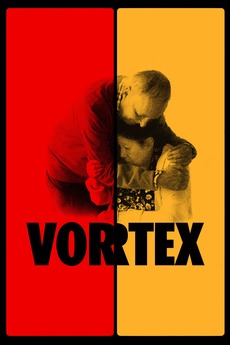
Finally fully transitioning into slow cinema, Noé finishes out his current filmography with Vortex, a heartbreaking look at the final days in the lives of a loving elderly couple. As he had incorporated aspects of slow cinema into the previous two films, the transition feels very natural despite the very different approach here, compared to Noé’s earlier works. Long takes, minimalist storytelling, and extended duration are techniques used in many of the films I’ve already discussed, and they all come together here without the usual extreme content to give us the most personal and heartfelt story so far.
Although there isn’t anything crazy to see in this movie and it’s actually pretty boring at times, it has stayed with me a lot longer than any film I’ve ever seen – as a matter of fact, I sat and stared at the screen for at least three minutes after it ended, thinking about it.
The extent of the plot is pretty much all found in the synopsis: a man and his wife deal with the imminence of their deaths, as she begins to experience some form of dementia and his health problems continue on a downward spiral as well. In the end, they both pass away and are survived by their estranged son, who holds funerals for his parents and reflects on the lives they had led.
What I really liked about Vortex was how unafraid it was to show life as it is without shame or particular care for pacing. There’s no sugar coating the couple’s situation, but there’s also no exaggeration of their relationship either; they’re regular people who lead regular lives and have regular conversations. It’s boring to watch at times, for certain, but I feel like emphasizing the downtime we all have in life is something that is rarely explored as deeply as in slow cinema, and especially in this film.
There are entire shots of characters napping, sitting at their desk working, sitting on the toilet, walking around the house, or watching TV. There are relatively pointless conversations that carry deeper symbolic meaning, mostly in the sense that these conversations are important because they show what these doomed characters are thinking about in their final hours. A lot of these things are everyday fare for us, but in the context of these characters’ lives, their discussions tell us so much about who they are and what parts of life are important to them.
That’s really the only thing I don’t like about the film, though: it can be a slog to get through at times. There have been boring segments in Noé’s films up to this point, but this one feels like the whole film is the boring segment – it works for the subject matter and Noé’s portrayal of the story, but you definitely have to be prepared for it to be more of an ambient experience than one to really be entertained by.
What really moved me was the cinematography choices and the film’s ending. In the beginning, we see the two happy together, and the screen is formatted like any normal movie, just one shot at a time. Then, when dementia sets in on the wife, the screen slowly splits into two shots simultaneously throughout the story, one focusing on each main character. Even when they are spending time together, their shots are separate, keeping them from fully sharing the screen in the same perspective again for the rest of the movie. In the end, when the husband dies, his half of the screen is completely empty space, and the wife continues her life in her half of the screen, emphasizing the void that was left when the husband had passed away. When she dies, the screen goes completely blank, with only a brief epilogue portraying her funeral and the cleaning out of their apartment.
In the final sequence, we see the home we had become familiar with throughout the film slowly cleared into emptiness, holding none of the couple’s personality that they had decorated the space with in their lives. And that’s what’s been on my mind so much: the film’s heartbreaking examination of how life continues to move on after death, and how the places we have made our memories remain empty, waiting for someone else to make it their own. It’s something I’ve never seen communicated so well in visual art, as death is generally used for narrative purpose or shock value, never as it really exists in the modern world.
Final Conclusion… Until He Drops Another One
For such a dramatic shift in genres – moving from purposefully shocking extreme cinema to the absolute minimalism of contemplative slow cinema – I’d expect any director to struggle maintaining the same artistic depth in their work. With a mind like Gaspar Noé’s behind the camera, not only does the artistic depth remain, but it’s actually empowered by the change. If Vortex was made like his past work, it wouldn’t be nearly as powerful, the same as if Irréversible was made as a slow cinema film.
What makes this shift possible is the fact that Noé has always used the basic plots of his films as grounds for philosophical discussion, only utilizing the New French Extremity movement as license to tell the intense, harsh stories he meant to tell. Although the graphic content of his films has subsided in the last decade, the intensity hasn’t left in the slightest; even despite Vortex being the lightest film content-wise, it has stayed with me much longer than I Stand Alone.
I’ll always be on the lookout for another Noé feature, as I’ve never been moved so consistently by the work of any filmmaker – he’s someone I genuinely look up to in terms of using themes to communicate purpose in storytelling.
If you’re looking for something to cleanse your movie-going palate after yet another Marvel movie or pointless remake to confront the dark parts of life for fun, try one out! Most of his movies appear periodically on streaming services like Netflix and Shudder, and Vortex, Enter the Void, and Lux Æterna are all currently streaming on Kanopy, which is free to all Pellissippi State Community College students with your school email.