
By Rebecka Jones, Staff Writer, and Emma Reagan, Staff Writer
Did you know you can donate to Veteran students here at Pellissippi State Community College? As we highlight Veterans Day, we at Imaginary Gardens invite you to join us in recognizing and honoring Veterans’ valiant service by investing in their future through the Veteran Support Fund. Just click the link below, select your donation amount, and designate your contribution to the “Veteran Support Fund.” Imaginary Gardens appreciates your generous support.
Thank you, and have a blessed day honoring this nation’s current and retired soldiers,
– Emma G. Harrison, Editor-in-Chief, Imaginary Gardens
Give to the Veteran Support Fund.
Background
In Fall 2025, the Faculty Senate of Pellissippi State Community College created a committee to make and send out a survey to all faculty, including adjunct professors and the deans. The Faculty Senate Climate Survey was distributed in April 2025, and the results and analysis of the survey were distributed in October 2025. Recently, a slightly modified survey with accommodations to participant suggestions was distributed in April 2026, drawing 183 responses in Spring 2026 and up to 149 in Fall 2025.
The survey was voluntary and anonymous, including Likert-scale items, where staff could score their feelings on a scale, and open-ended qualitative sections allowing them to write their own response on climate and institutional changes at Pellissippi State. Quantitative questions and responses allow for more specific data tracking and the ability to clearly find patterns and solve problems based on the data. Qualitative allows the staff to state the problems and propose solutions on their own, giving specific feedback to the school without fear of repercussion.
As in Fall 2025, local machine learning tools such as JAN, Mistral, and Llama assisted in writing R analysis scripts. However, AI assistance was limited to code generation and explanation, not interpretation of results or generation of findings. All analysis was run on local machines, and no survey data was used to train any AI platform.
The committee coded open-ended responses in Excel and StatCrunch, allowing the free-response answers from staff to be turned into specific data points, finding repeated themes and opinions.
Comments were collected in open-text fields attached to specific questions or to a group of related questions. Because not every participant answered every item, response counts vary from item to item, and percentages may not total exactly 100 due to rounding.
Report Analysis
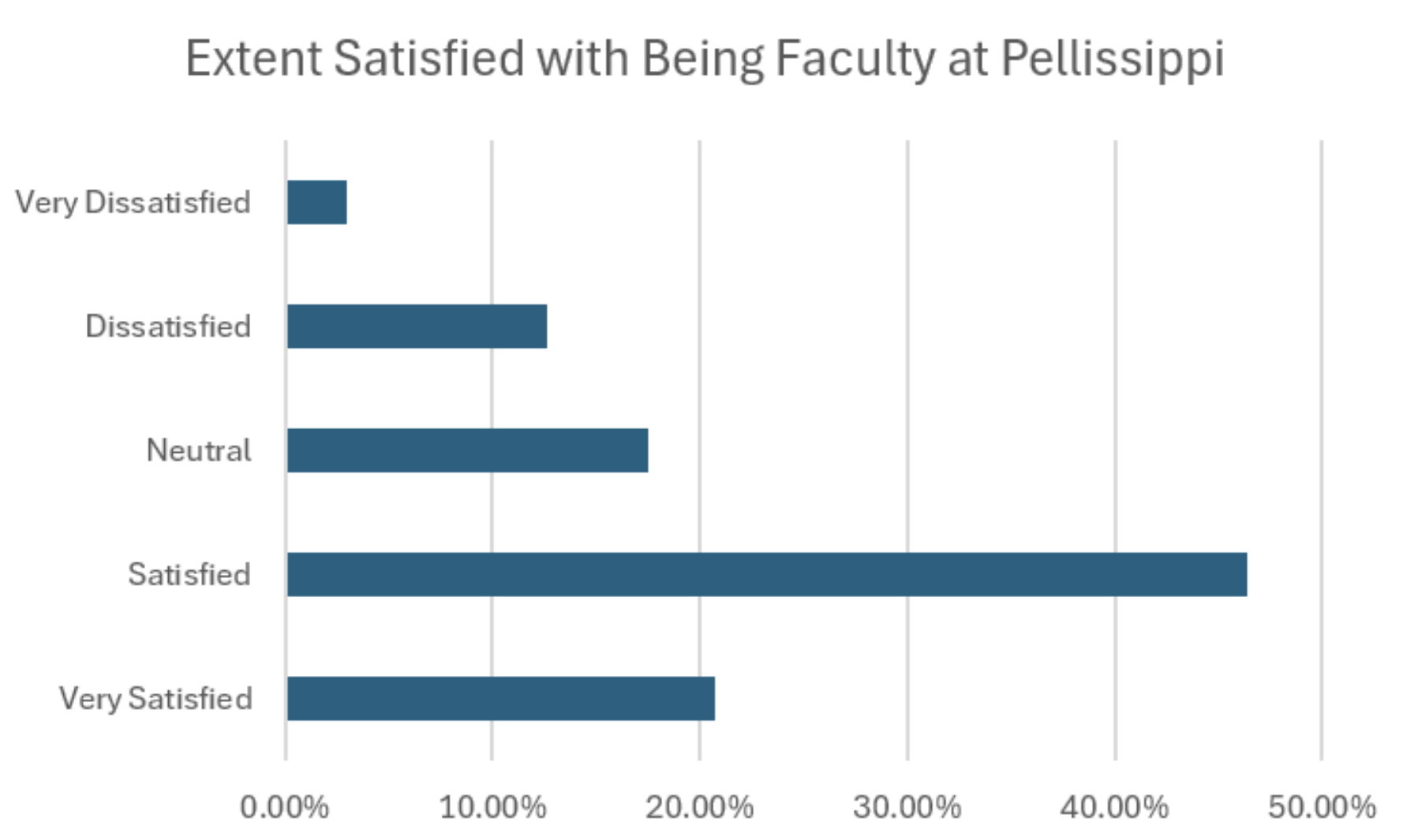
The overall satisfaction with being a faculty member at Pellissippi State was measured and displayed on Graph A of the Faculty Climate Survey results. The bar graph includes the categories very satisfied, satisfied, neutral, dissatisfied, and very dissatisfied. The survey revealed that 38 (20.7%) were very satisfied, 85 (46.4%) were satisfied, 32 (17.5%) were neutral, 23 (12.6%) were dissatisfied, and 5 (3%) were very dissatisfied.
In the written responses, adjunct faculty describe feeling overwhelmed, underpaid, under-supported, and underappreciated. Responses included reactions to bureaucracy and organization of the institution, some describing how the transition was disorganized, accessibility concerns, and insufficient support for career-tech.
Regarding administration, responses said that it was top-heavy, administrators did not listen to faculty concerns and suggestions, there was no accountability, and there was a lack of communication. Responses about morale centered on feeling unrecognized and on a loss of community.
Moreover, comments on workload explained that there was uncompensated extra work. On the other hand, a minority of comments were positive and most focused on students and the classroom, explaining that they felt rewarded, appreciated, and happy.
Graph B is a pie chart displaying faculty responses in terms of their desire to find a comparable job elsewhere or stay at Pellissippi State. 106 (58%) said they would remain at Pellissippi State, while 77 (42%) said they would leave.
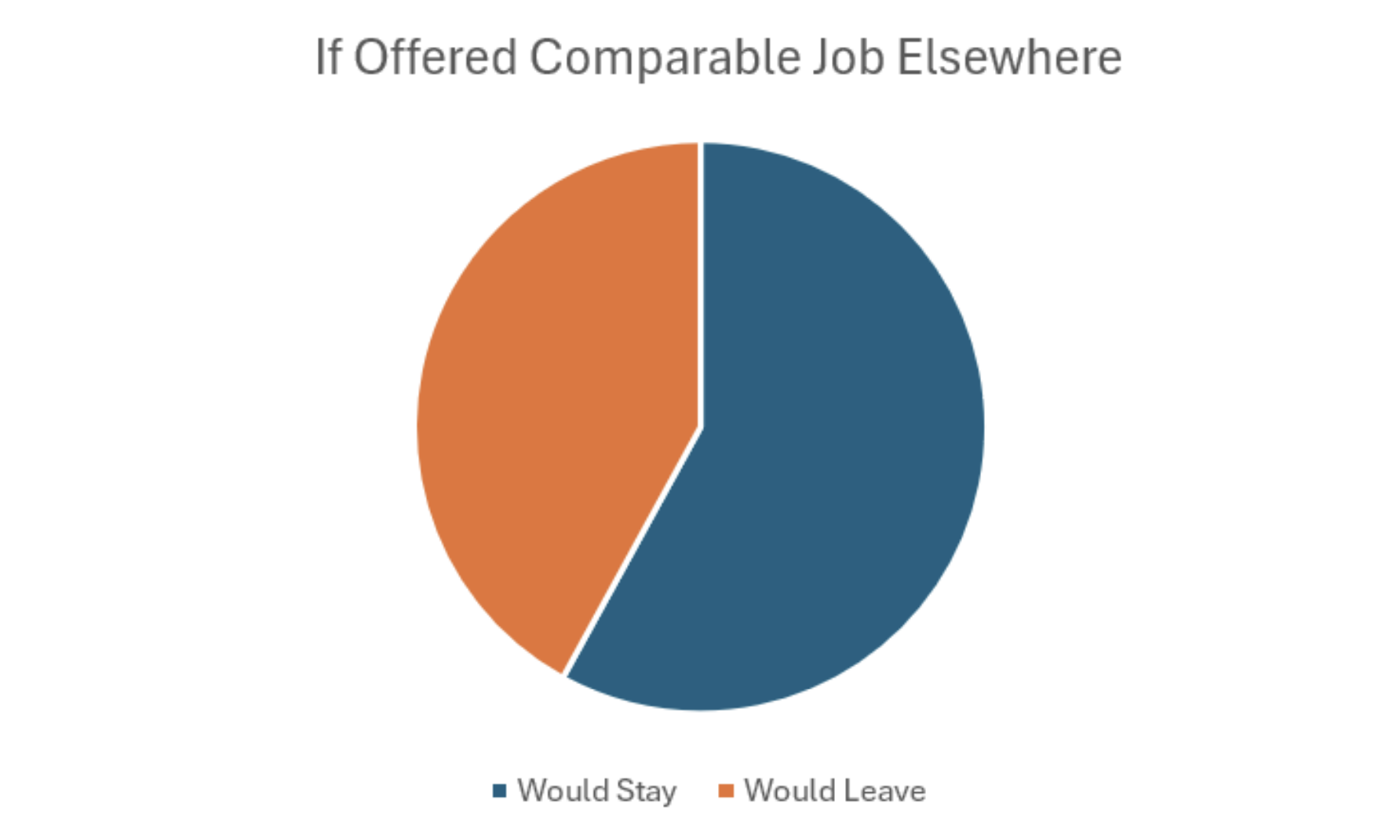
Many faculty who voted they would leave said it was because of the word “comparable.” They explained they were happy working at Pellissippi State but said they would still leave for a job offering higher pay and better opportunities, so their answers were not out of dissatisfaction with the college.
The comments regarding this section centered on pay, workload, and administration. Faculty members desire higher pay as the cost of living in Knoxville rises and more communication among administration, and faculty are dissatisfied with administrative work. Adjunct faculty specifically wished for more full-time opportunities and described feeling disrespected. Morale-themed responses explained a lack of support from administration.
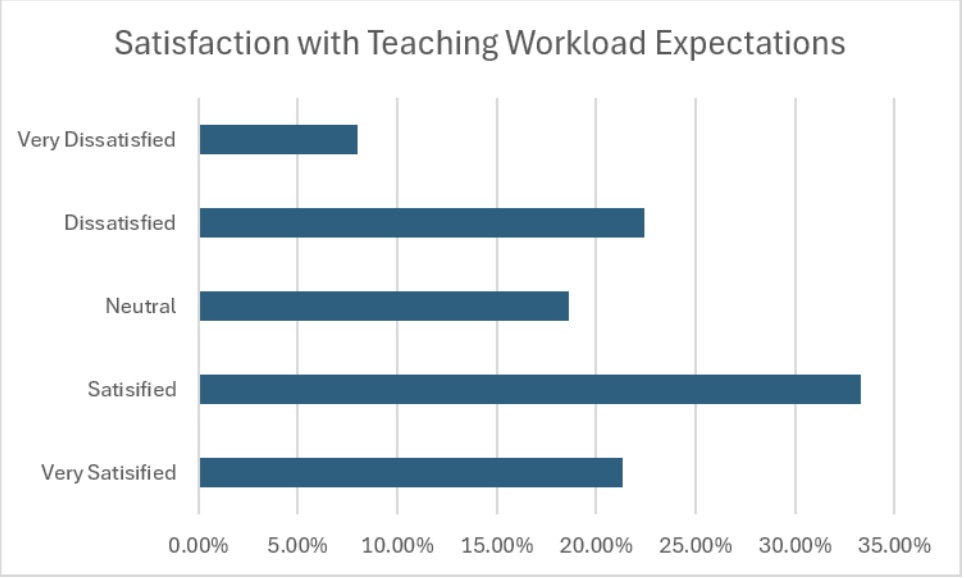
In Graph D, faculty were asked to rate satisfaction with teaching workload. 39 (21.3%) were very satisfied, 61 (33.3%) were satisfied, 34 (18.6%) were neutral, 41(22.4%) were dissatisfied, and 8 (4.4%) were very dissatisfied. With some feeling dissatisfied, this may raise questions as to how our college can improve on grading systems, curriculum, and lesson planning. Considering many reported being satisfied, faculty may have opportunities to learn from each other.
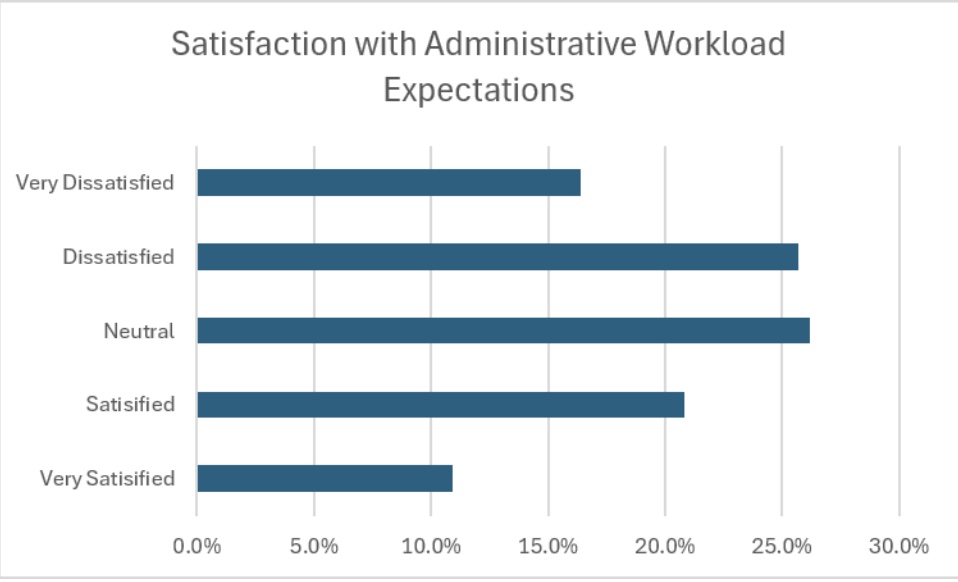
Graph E reflects how faculty feel about administrative workload expectations. 20 (10.9%) were very satisfied, 38 (20.8%) were satisfied, 48 (26.2%) were neutral, 47 (25.7%) were dissatisfied, and 30 (16.4%) were very dissatisfied. Considering many reported dissatisfaction with administrative workload, this may raise concerns about staffing and systems of recordkeeping. There is also a possibility that administrative workload prevents faculty from meeting teaching expectations.
Conclusion
Why are these responses important? Faculty well-being can impact many aspects of the college administration. The responses are important because they tell us the areas in which we need to improve as an institution and how we can support our faculty. Faculty are the heart of our institution, so we must work to improve their environment. 42% of staff members would leave if presented with a better opportunity; this survey tells us that if we don’t show our appreciation for the work our staff here at Pellissippi State does, there could be consequences.