By Kyle Cantrell, Special to the Journal
The world we live in today is something that has never been seen before. Twenty-five years ago, the biggest technological advancement was having access to the internet. But somehow, that was only the beginning. In just a matter of years, we have been introduced to social media, smartphones, AI, and many other services that the modern world simply can’t function without. However, through all this progress, a quiet habit slowly started infecting our everyday lives. Almost every person on the planet is a victim of this habit and most don’t even realize how far they’ve fallen into it. It has slowly taken over our attention spans and keeps us glued endlessly to our screens for hours. I am, of course, talking about doomscrolling.
Everyone has experienced a scenario where it’s late at night or you want to take a break from whatever task you’ve been doing. So, you decide to go on your phone and relax a bit. You open Instagram or TikTok and start scrolling. What was supposed to be a five-minute break or a quick phone check before bed has now turned into hours of scrolling. Suddenly, it’s now 3 a.m., and you have missed out on a good night’s sleep, or you’ve looked back on your task and realized that you have accomplished nothing and have wasted hours just mindlessly scrolling. The question is, why can’t we stop? Is it because we’re lazy and just don’t care enough to stop, or do we just lack discipline?

Sadly, the real answer isn’t so simple. In reality, we can’t stop because these apps are designed so that we never stop. Every feature you interact with on platforms such as TikTok, Instagram, or X has been carefully engineered by teams of developers and psychologists whose entire job is to make sure you never want to put your phone down.
According to a study published in Perspectives in Public Health, “over a billion people spent an average of three hours a day scrolling through social media in 2020 and that number has only grown since… The platforms achieve this through features like infinite scroll, autoplay, and pull-to-refresh, all of which exploit our brain’s dopamine response, releasing small hits of reward with every swipe.”
If the average person spends three hours a day over the course of a year, that is 1,095 hours, or 45.6 days nonstop. That is 45.6 days you lose to your phone. What’s worse is that we do it unknowingly, but it’s not our fault. We aren’t weak for falling for this trap; these things were designed specifically so that we never stop.
Now, I’m not just talking out of my butt over here. I, too, am a victim of the algorithm. There have been many times when I’ve lost hours of my life to scrolling. However, the story that would best get my point across was when I woke up on a Saturday and immediately opened my phone. I started scrolling and, after some time passed, my friend sent me a podcast and told me to listen to the first couple of minutes. Those first couple of minutes were about how doomscrolling is controlling us and how you can easily lose hours of your time and never stop.
Sure enough, when I looked at the time, I realized that I had spent the first three hours of my day just scrolling endlessly and being unable to stop. As a result, my brain was fried for the rest of the day, and I felt like a brain-dead zombie because, in a sense, I was. That’s three hours of my day gone, not to something that made me better, smarter, or happier, but to an app that was designed to make sure I never stopped.
Furthermore, as a college student, doomscrolling is something I witness every single day. I sit in class and watch people around me pull out their phones while the professor is talking. They aren’t looking something up or checking an important message; instead, they doomscroll, and I can’t help but wonder, are they doing it consciously? The thing that hits me the most is their body language and facial expressions. Many look like zombies, almost like their brains are swallowed by the algorithm, and their bodies are just on autopilot.
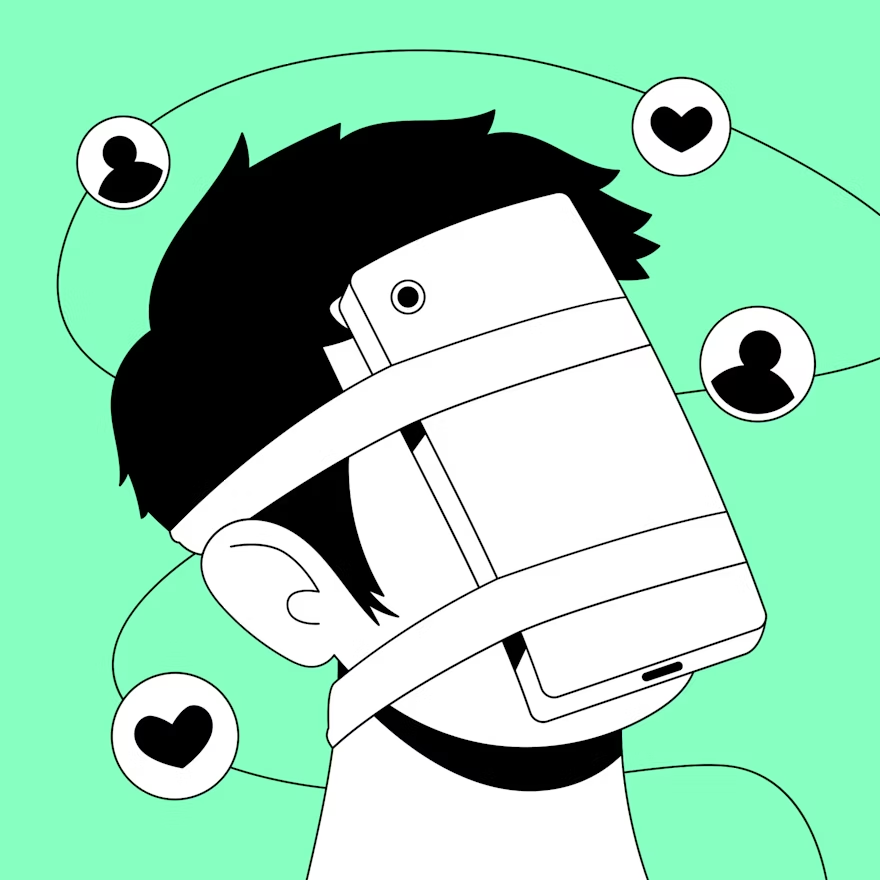
To sum it all up, they show no emotions, just eyes lost on a screen. These students are physically present but mentally gone. Doomscrolling fries your brain, so when they finally do look up, will their brain even be able to retain what the professor just said? Moreover, if students can’t stay present for an hour-long lecture, how are they supposed to develop critical thinking, retain information, or build the mental discipline that real life demands?
So, what could you do to minimize the algorithm controlling you? Well, at the end of the day, there is no permanent solution to this issue. Social media will continue to get more powerful and bigger each year. What’s worse is that the younger generations are now growing up on this. People born before this wave of technology had the luxury of enjoying the real world, with a solid understanding of what the real world actually is.
As social media expands, kids will now only know what they see or only what the algorithm lets them see. In short, the algorithm keeps them in a bubble and warps their perspective on reality because they see all these things, whether it’s riches, women, or an idea that they think is true, just because an influencer said so. I especially fear for the younger generations’ confidence and self-respect levels because now kids are basing their worth on likes, followers, or the attention they get from their socials. Not to mention how doomscrolling fires dopamine signals, which is worse for kids because they haven’t had time to develop real dopamine levels, so they will now forever be searching and looking for instant dopamine.
The solution starts with awareness, not just for kids but also for us. My advice is to seek real dopamine. For example, a walk or a plunge into cold water, or just hanging out with your friends without the use of screens. Just anything real; that would be a good place to start. I would also suggest setting boundaries with your screen time. On top of that, if you’re one of those people who don’t think it’s affecting you, all I ask is that you try this experiment; the next time you catch yourself scrolling, ask yourself what the second-to-last reel you just watched was. I bet you wouldn’t be able to answer that question every single time. Overall, you can’t delete the algorithm, but you can refuse to let it think for you.