By Sydney Caulfield, Special to the Journal
How does one define humanity? What differentiates a human from what humanity creates to mimic itself? If there is a theoretical history of fearing the incomprehensible, what are these horrors that have caused this deep-rooted terror of enigma, and where do they come from?
Mary Shelley’s Frankenstein demonstrates the amoral sublime, the fear of manufactured intelligence, and hypothetical consciousness in a nonhuman entity. I believe that Frankenstein’s monster is the most basic form of artificial intelligence and foreshadowed the fear of human-like intelligence in a non-living being. Additionally, evidence supports the claim that the amoral sublime present in Mary Shelley’s Frankenstein directly foretold the archetype of wickedness in artificial intelligence.
Although artificial intelligence is fascinating, it is alarming to consider the extent of socialization with it as if it’s capable of contributing complexly to human conversation. This compels one to wonder if creating artificial intelligence is ethical, or if it’s simply another amoral tool at the use of humanity, capable of both good and bad.
Amoral sublime is a term I developed to express the expansive horrors of the absence of ethics. It is best defined as the sensation of the sublime heavily influenced by a lack of moral obligations. As defined by the Norton Anthology of English Literature, sublime “refers to the realm of experience beyond the measurable, and so beyond the rational, produced especially by the terrors and grandeur of natural phenomena.”
As a horror novel published during the British Romantic movement, it makes sense that the sublime would feature so distinctly throughout the novel. Mary Shelley’s Frankenstein illustrates awe-inspiring landscapes and exhibits scientific impossibilities— both subjects crucial to representing the sublime. Science and nature beyond human comprehension invoke fear and awe in the audience. The main character of this tale, Victor Frankenstein, adds a complex, dark twist to the conception of the sublime.
Victor Frankenstein pursues the idea of reanimating a corpse without any regard for the consequences, bringing back that idea of the amoral sublime. In this case, I argue that the fantastical idea of monstrous creation without forethought should be considered a subtype of sublime. Not only is it founded on the concepts of terror, life, and the beyond, but also ignorance, recklessness, and naivete. The amoral sublime invites the idea that the sublime is within human reach; not only that, but its morality is influenced by humanity. Victor Frankenstein’s lack of restraint and morality, combined with his unwavering passion, persistence, and determination, directly contributes to his creation’s wrath and suffering.
Frankenstein dedicated “nearly two years” of his life to this undertaking, depriving himself of the most basic needs required for a human to function; he barely eats, he barely sleeps, and hardly spends time outside. Upon his unforgivable accomplishment, Victor Frankenstein immediately surges with regret the moment his dream comes to fruition:
“How can I describe my emotions at this catastrophe, or how delineate the wretch whom with such infinite pains and care I had endeavored to form? … I had desired it with an ardour that far exceeded moderation; but now that I had finished, the beauty of the dream vanished, and breathless horror and disgust filled my heart. Unable to endure the aspect of the being I had created, I rushed out of the room.”
His abandonment of the intelligent creature solidifies the lack of responsibility and accountability that Victor Frankenstein should have readily possessed, given the disquieting ambition he so resolutely held.
Because Victor Frankenstein observed the capacity of the creature’s intelligence, he should have taken responsibility and chosen to foster the creature’s education. Because of Frankenstein’s abrupt departure, the creature was abandoned to the workings of the world and the cruelty of society with nothing but the initial memory of neglect and forsakenness.
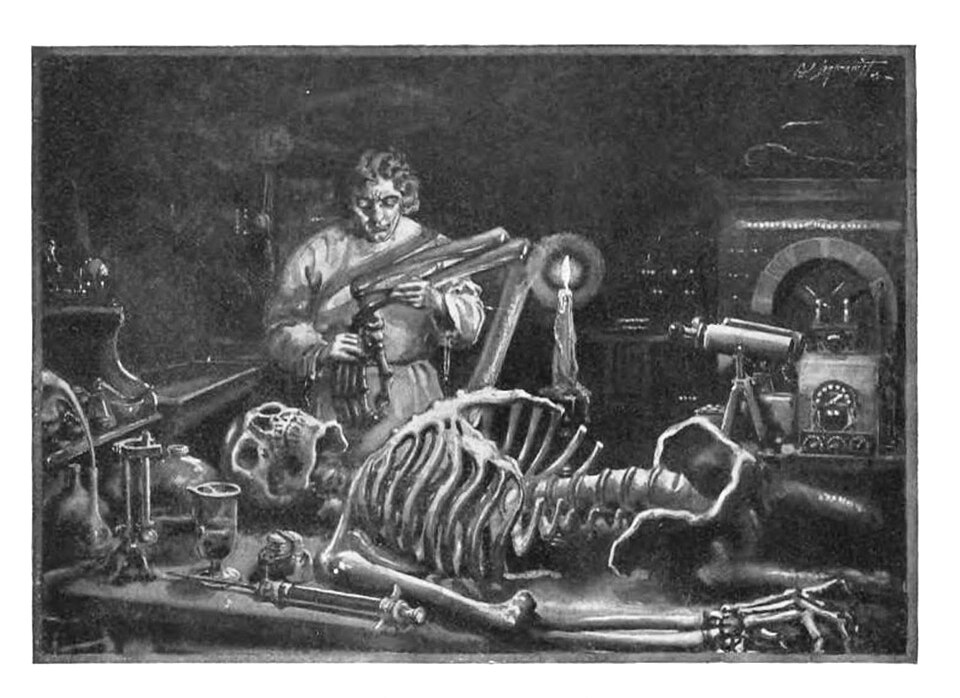
In Volume II, Chapter III, the creature expresses its anguish due to lack of guidance upon entering the world, “How can I move thee? Will no entreaties cause thee to turn a favorable eye upon thy creature, who implores thy goodness and compassion. Believe me, Frankenstein: I was benevolent; my soul glowed with love and humanity: but am I not alone, miserably alone? You, my creator, abhor me; what hope can I gather from your fellow-creatures, who owe me nothing? They spurn and hate me.”
The reader may notice how the creature distinguishes itself from humanity by referring to humans as Frankenstein’s fellow-creatures. The creature recognizes that it is an entirely different species, but nevertheless attempts to show Victor Frankenstein the authenticity of its own emotions. The insistence of the creature’s human-like capabilities leads to the predicted archetype in which humanity would eventually come to fear: manufactured intelligence and hypothetical consciousness in a nonhuman entity.
In Volume II, Chapter IV, the creature illustrates its observation of the family who lived in the cottage: “I perceived that the words they spoke sometimes produced pleasure or pain, smiles or sadness, in the minds and countenances of the hearers. This was indeed a godlike science… when they were unhappy, I felt depressed; when they rejoiced, I sympathized in their joys.”
Through observation, the creature learns how to mimic human emotion. Although observation is the standard mode to absorb information, I argue the information already exists within the creature due to the origins of its brain: a brain from an established human being before its reanimation. It is effortless for the creature to produce this knowledge because the brain stored this information in its last life. It is there and available, but to access it, the creature must be reminded of it, or in other words, prompted. This trait is reminiscent of modern artificial intelligence, requiring humans to upload materials in order to access and retrieve the information at a later date.
The creature compares itself to the humans, fooling itself into believing that, because it had organs and could speak, it was essentially human, too. The creature is incapable of original thought, merely mimicking the abilities, desires, and emotions of humanity. Could one not say the same for modern-day artificial intelligence?
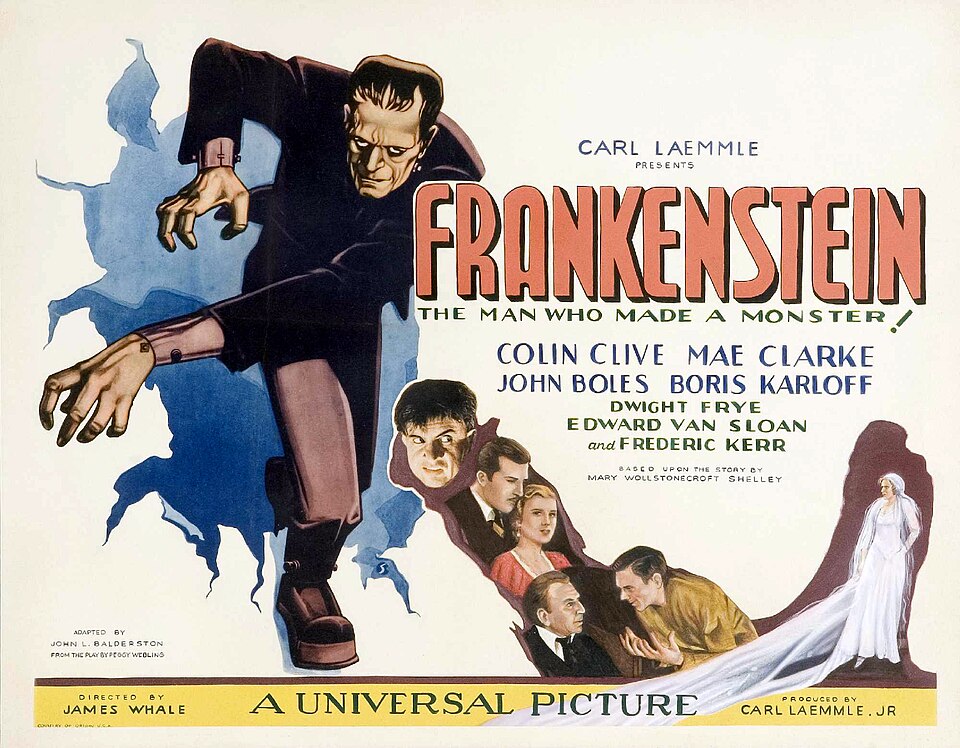
It exhibits emotion and can behave as if it were unaware that it is a creation of science and technology. Artificial intelligence cannot produce original thought, a trait that both modern artificial intelligence and the creature share. Have we not witnessed this archetype in film in recent years? Characters personified with human depth and intelligence, such as Sonny in iRobot or Agent Smith in The Matrix, are prime modern examples of this.
What do Sonny, Agent Smith, and Frankenstein’s monster all have in common? They are sentient, non-human entities that humanity fears due to their amoral creation and execution of human-like intelligence. All things considered, does this make artificial intelligence the modern-day monster?