By Heather Lee Schroeder, Faculty Advisor
“What did you eat last night?” Melanie asked the group.
The leaves from the trees that sheltered the playground drifted down to land on the concrete, creating whorled patterns of color on the gray expanse. A group of our classmates stood in a circle, suddenly too old and too cool to play on the swings or other equipment.
I was in fifth grade, living in northern Illinois in a Victorian-era home that was heated with wood. My peers lived in town or in the growing suburban spaces that were gobbling up prime farmland. I didn’t make eye contact with any of them because I was acutely aware that I didn’t want the question to circle around to me.
“Gross roast beef,” one of my classmates said. I thought of tender slices of beef drizzled with gravy, and my stomach clenched with hunger. “But we had chocolate pie for dessert.”
“Chicken and dumplings. My mom knows I hate that,” another classmate grumbled. I thought of flaky biscuits that had soaked up the broth of the chicken, and I felt lightheaded.
I understand hunger—real hunger that shapes one’s life, the sort of hunger that feels like a shameful personal secret, but that is really a shameful societal problem.
“What about you, Heather?” Melanie asked, emphasizing my name in a dangerous way. She was my chief tormenter—a queen among the town kids and the architect of our emerging social hierarchy of haves and have-nots.
I looked down, and I felt a hot flush rise up my body. I didn’t want to answer and I thought about lying. I had recently been caught in a whopper of a fib about my dad being famous (which he was, but only among spelunkers in Arkansas), and I had paid the price, socially, for lying about my circumstances. Still, I knew how risky it was to reveal the truth.
“Come on!” Melanie said. “What did you have?”
“Chicken gizzards and beets,” I whispered. My cheeks flamed, and it felt like they might melt off.
“Chicken what?” Melanie shouted. “Ewwww, beets. So gross!”
Everyone laughed. I felt the weight of my rural upbringing and the poverty that draped over my family like a leaden blanket.
“Gizzards,” I replied. “They’re like liver, but tougher.”
Jeremy, who I had recently learned had a rotten heart at his core, made retching noises. His best friend, Dan, laughed on cue.
“Poor people food,” Melanie said. “You eat poor people food!”
I did, in fact, eat poor people food. I’m not even sure where my mother, who was a single parent with no child support from my father, got the gizzards, but they were pennies per pound—a waste product for most cooks, but a high-protein option for her. The beets had come from our garden and we had pulled them from the ground moments before scrubbing them up and cooking them. She had put aside the greens for sautéing the next day.
My mother was a disinterested and uninspired cook most days, which is why her chicken gizzards were tough and unappetizing. My grandmother, on the other hand, who had grown up in a culturally German-Jewish household, had learned to cook the pipiklach with onions and paprika, and although I didn’t love them, they weren’t quite as inedible as my mother’s were.
When we ate gizzards, my mother would tell me that having to chew my food a lot slowed me down and filled me up faster.
“They taste like the dirt that they grew in,” she would say about the beets.
She spent a lot of time trying to convince me that our specific brand of hunger was normal, maybe out of guilt or out of emotional self-preservation. When we had liver—another cheap protein—she would announce that we were eating every part of the animal, which was a good thing. When she could afford to relent and buy me a luxury item, she would choose the store brands and decant them into empty brand-name boxes she lovingly saved in our pantry. Pop-Tarts, Rice Krispies, and Frosted Flakes were the forbidden and desirable “junk” food that I rarely had. She was fooling no one, but we pretended that the store brands tasted the same. We grew most of our vegetables, but fruit was a luxury that we couldn’t afford. Unless it was crabapples from my grandfather’s orchard or berries we picked from the roadside, we ate tinned fruit when we could afford it.
Once a year, at Christmas, she would fill my stocking to overflowing with the good fruits—oranges, plump grapes, pears, bananas, and juicy perfect apples. I savored this bounty for days, rationing it out like a banker, calculating exactly how to get the most enjoyment out of each piece.
I didn’t love our poor people meals, but I was a hungry kid. Hungry kids tend to eat what they are given. I knew that my classmates came home from school to overflowing snack bins and a full, luxurious dinner every night. If they were hungry, they and their parents had a meal. In contrast, my mother often would skip a meal to make sure there was enough for me with some leftovers for the next day. Snacks were a rarity, not a regular occurrence. I was hungry a lot.
Today, I’m lucky enough to have ready and easy access to food, but I remember my shame about eating what my peers deemed substandard meals and I remember what it was like to feel hungry much of the time. Child hunger is a problem in the United States.
According to the nonprofit No Kid Hungry, 44 million Americans were living in poverty in 2025, of which 10 million of those individuals were children. Using available data, 13.4 percent of American children were living in poverty in 2025. By contrast, only 5.2 percent of children were in poverty in 2021 when the enhanced child tax credit was introduced. (This has since expired and not been renewed by Congress.)
However, just because a student grows up and leaves the K-12 system doesn’t mean they are suddenly fed. Alarmingly, hunger among college students is on the rise. In 2023, the National Center for Education Statistics released a report titled the 2019—20 National Postsecondary Student Aid Study (NPSAS:20), which indicated that 23 percent of undergraduates experience food insecurity and 8 percent experience homelessness. Although there are some caveats around this study, it remains one of the best windows into the struggles of students in higher education.
Many of the professors who teach our classes and guide our students to their successful futures are hungry too. A study from the Hope Center for College, Community, and Justice revealed that even before the SARS-COV2 pandemic hit, “nearly four in ten faculty faced some form of basic needs insecurity over the previous year.” Thus, the people who are meant to look for signs of hunger in the classroom are, themselves, hungry.
I understand hunger—real hunger that shapes one’s life, the sort of hunger that feels like a shameful personal secret, but that is really a shameful societal problem. I understand how, on a societal level, we have reduced poverty to a personal failing, not an indictment of systems that do not work for the many.
In the dark season of the year, our thoughts turn to generosity and thankfulness, while simultaneously, people often feel the most desperate.
With that in mind, here are my challenges to you to make our Pellissippi State community better this holiday season.
Challenge 1: Talk and Think About Poverty Differently
At the most fundamental level, the way we collectively talk about poverty doesn’t work. We often judge people who can’t afford groceries or people who have to choose between filling their gas tank or filling their bellies. The general thinking seems to be that people who are living in poverty deserve their situation.
The lyrics from the song “Why We Build the Wall” from Anais Mitchell’s Broadway musical Hadestown come to mind when thinking about how Americans frame poverty. Hades, the god of the Underworld, walks his enslaved workers through a series of questions, beginning with, “My children, my children. Why do we build the wall?” The enslaved chorus sings, “We build the wall to keep us free.” Eventually, he sings, “Who do we call the enemy?” and the chorus replies, “the enemy is poverty and the wall keeps out the enemy and we build the wall to keep us free.”
It’s not by chance that this version of Hades, who is portrayed as a trickster who gets what he wants by any means necessary, asserts that the enemy is poverty, not the system that creates inequality. Mitchell critiques the rhetoric that shapes how many of us see poor people. (Notably, Eurydice sells her soul for food.)
Unlike Hades, I hope we can all agree that a basic human right should be to have food on our plates and shelter over our heads, regardless of any decision we’ve made or problems we might have.
If you tend to think that the world is made up of deserving haves and undeserving have-nots, I encourage you to look at what groups experience the highest rate of poverty in this country: children, senior citizens, and people living with disabilities. I would further add, as a caution, that most Americans are just a health emergency, a job loss, or an unexpected disaster away from a similar situation. It doesn’t take much to fling an otherwise fully contributing person into extreme circumstances.
If you are a person who is experiencing homelessness or hunger, I encourage you to speak up. Talk to a professor, talk to a supervisor, talk to a friend. If you feel like you have no one to help you, stop by the Imaginary Gardens newsroom, and one of our faculty mentors will get you connected to resources, including counseling services, the Pellissippi Pantry, and, if needed, housing resources.
Staying silent about this type of suffering encourages people to think it’s uncommon and related to individual failings, both of which are untrue. If we talk about what our community needs, we can create meaningful conversations about how to meet those needs.
Challenge 2: Support Individuals
When I first came to Pellissippi State, I became friends with Professor Ed Francisco, the college’s writer-in-residence. Over time, I came to realize that he understood poverty too. Most people never knew that he paid for people’s utility bills. He bought bags of groceries. He slipped single-parent students a $100 bill to pay for new clothes for their children. He bought hungry students lunch in the college cafeteria. He, like me, knows why poverty feels like shame.
Because of the way that Ed gave to students, I learned to keep a full cabinet of snacks in my office. When a student comes in shaky with hunger, I can give them something to tide them over. I’m not alone in doing that. I’m not alone in addressing individual hunger on campus; I have many colleagues who step up to help individuals.
Associate Professor Anna Matsen, another Imaginary Gardens faculty advisor, and I purchase snacks, on our own dime, for the Imaginary Gardens staff, but we’ve also brought hungry students into the newsroom to fill their backpacks with whatever they need to get them through today and maybe tomorrow. Then, with the help of a resource tool Anna has created to share with students, we connect them to on-campus assistance. Informally, Anna and I have agreed that no one will go hungry under our watch.
Challenge 3: Use and/or Support the Pellissippi State System
Yet the answer to poverty isn’t individual solutions. Addressing food insecurity, housing issues, and other disasters requires a systematic approach. At Pellissippi State, we have resources for our struggling students, faculty, and staff.
English Professor Annie Gray recognized the need to support the entire student body, and she built the Pellissippi Pantry and the Pellissippi garden from the ground up. Although Dr. Gray no longer runs those projects, her contributions to the well-being of our students, faculty, and staff are immeasurable, and her work is carried on by the Pantry staff.
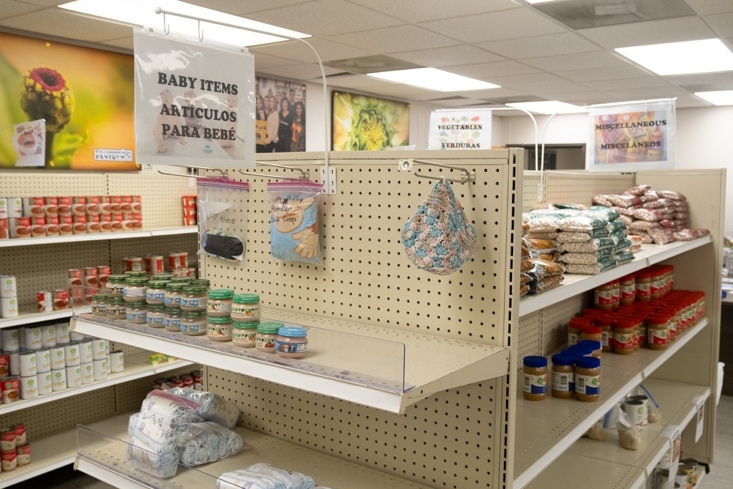
I am proud to say that I am a donor to these efforts. I give money to the Pantry, the garden, and the Homeless Student Scholarship every month, and I know that many of my colleagues do the same. Those monthly contributions help fund the Pantry’s targeted purchases of the most necessary items. If you feel you can contribute similarly, I urge you to do so. The Pantry has remarkably low overhead, and the managers are able to stretch every dollar to benefit the community.
Users of the pantry are allowed to use their points to “purchase” items in the on-campus grocery store. The Pantry often has perishable items that don’t count toward points, which adds to the variety and selection of items for shoppers.
Another way to contribute is to regularly purchase items that the Pantry might need. Some donors regularly provide items that might not otherwise be purchased by the Pantry, such as pregnancy tests, feminine products, diapers, laundry detergent, and other toiletries. These items aren’t luxuries, and their inclusion on the shelves of the Pantry makes an appreciable difference in the lives of people who use the service.
Items that often are not donated but that can make a difference for food-insecure shoppers include spices, box mixes for cakes, frosting, special “treat” items, and cooking essentials like shelf-stable oils, sugar, flour, and other necessities.
If you are a person who is struggling with food insecurity, please know that the Pantry allows students, faculty, and staff to shop for the items they need, no questions asked. The staff’s commitment to a shame-free experience impresses me, and if you need the resources, I strongly urge you to connect with the Pantry and use the service, regardless of your status on campus. You deserve the support.
To show my commitment to the work of the Pantry and to this challenge, I am purchasing and donating two Walmart Meal Deals. This includes a turkey and all the traditional fixings. I’ll add some appropriate spices, sugar (cranberries need the full treatment, y’all), some oranges, potatoes, and boxed mac-n-cheese.
Imaginary Gardens is challenging you to do the same! If you feel that you can, please donate food and toiletries directly to the Pantry, or better yet, give monthly to the funds I’ve mentioned.

It’s a perfect time to give. According to Hayley Bisacre, the director of annual giving and donor engagement at the Pellissippi State Foundation, The Life Happens: You Can Help Campaign, which runs for the next two weeks, specifically highlights funds that assist with unexpected expenses, emergency funding or basic needs. It includes the following: First-Generation Scholarship; Veteran Support Fund; Homeless Student Scholarship; Pellissippi Pantry; Student Opportunity Fund; General Scholarship Fund; Campus Scholarships; and the Greatest Need Fund.
If you’re still feeling generous after giving to The Life Happens campaign, you can designate funds for Imaginary Gardens, along with other on-campus programs and initiatives, on Giving Tuesday.
Big problems require big solutions. Please join us in our work to end hunger on campus!