By Rebecka Jones, Staff Writer
A Museum of Local and Inimitable Art
You may not realize it, but you are surrounded by so much beautiful and meaningful artwork in Knoxville. Art is everywhere you look, whether it’s the painting in your living room, the ceramic coffee mug you drink from every morning, or even the Oarsman statue you may have walked past on the corner of Church and Gay Street downtown. Every piece of art we see is made with creative hands that have put a lot of thought and originality into their work. Moreover, what makes the art in Knoxville even more fascinating is that we have access to work created by people from our community and from all over Tennessee.
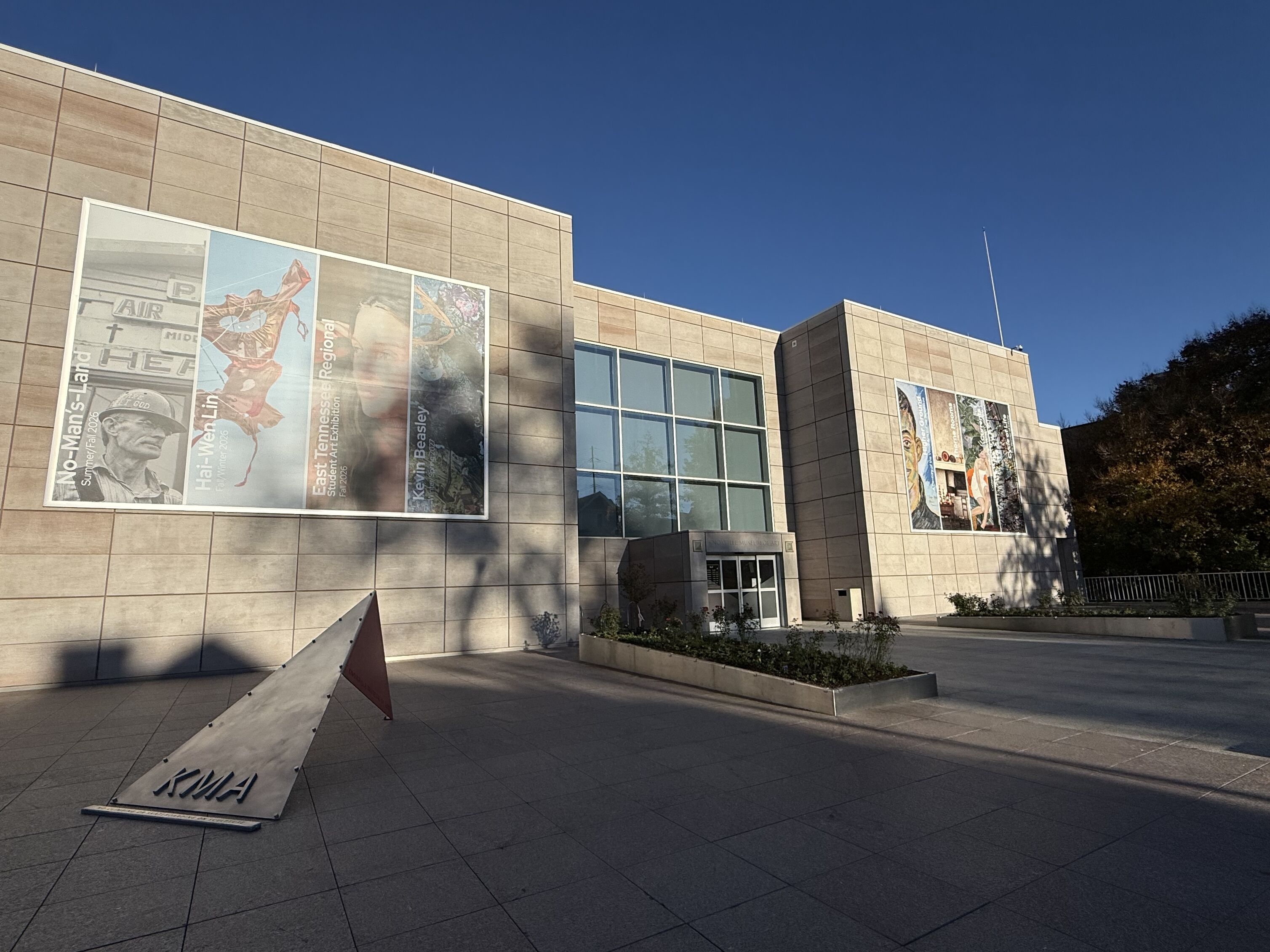
The Knoxville Museum of Art showcases rich and diverse art from East Tennessee and celebrates its beauty and connections to the wider currents of world art. Knoxville is fortunate to have an art museum with exhibits that include local and unique artworks. The museum has permanent exhibits such as Higher Ground: A Century of the Visual Arts in East Tennessee, featuring art from Knoxville and Appalachian environs from the 1860s to 1980s, and Cycle of Life: Within the Power of Dreams and the Wonder of Infinity, displaying one of the biggest figurative glass-and-steel assemblages in the world, commissioned in 2009.
On the other hand, the Knoxville Museum of Art features new and temporary exhibits every few months and currently has a student art exhibition with local artworks by students from surrounding high schools. Having access to these astonishing art pieces shows us the talent and passion of the artists in our community and beyond. There is so much color and detail to look at, and seeing the effort and emotion in these artworks is something to behold in itself. I enjoyed the time I spent exploring the beautiful pieces of this museum.
Tennessee High School Students at Work
The Tennessee Valley Fair Student Art Exhibition is celebrating fifty years of recognizing the next generation of artists, showcasing artwork from high school students all around Knoxville. This is a temporary exhibition at the Knoxville Museum of Art, set up on October 23, 2026, and will last until December 13, 2026.
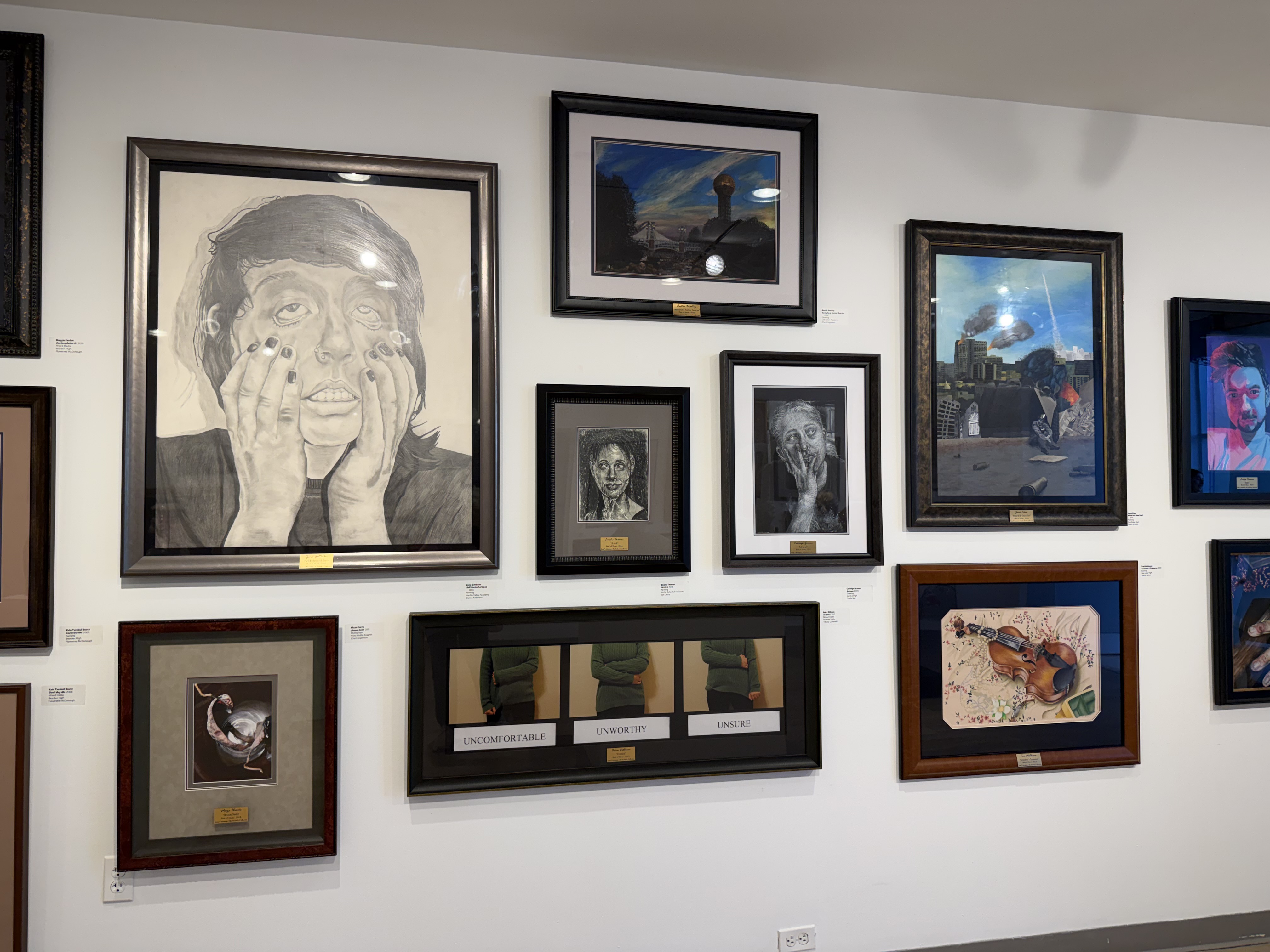
This gallery is a community in itself, representing the different art styles of students from many local high schools, including Bearden, Carter, Central, Gibbs, Halls, Hardin Valley Academy, Laurel, Oak Ridge, Roane County, Webb School of Knoxville, and many others. Every art piece was made with different materials, ideas, and creative minds.
There were painted pieces, including the self-portrait in the top left corner and the one to the right of it, the violin at the bottom right corner, and the city piece above it. I found it interesting all the different ways artists can experiment with paint. The artist of the self-portrait used a lot of blending of paint to make the shadows on the face and fingers come to life. Similarly, the portrait beside it added color tones with dark paint to make the face look as if it were in a black-and-white photograph. On the other hand, the violin painting included a lot of colors and texture to show the wooden material of the instrument and the softness of the flower petals beside it. Lastly, the painting of the city used neutral colors to display the devastation of war and solid textures that almost made it look like an oil painting.
Other works of art included photographs, such as the piece below the self-portrait, that capture real moments and objects the artist experienced. The way people can create art just by angling a camera a certain way and snapping a photo of something that exists will always amaze me, especially as someone who enjoys photography and desires to capture the beautiful and authentic nature of the world.
Another work was the mixed media piece in between the photograph and violin painting. Artists incorporating other forms of art into one is fascinating, including this piece that uses photographs and organizes them into a collage. Using more than one form of art opens up experimentation with 2D and 3D materials that create abstract concepts and sensory engagement.
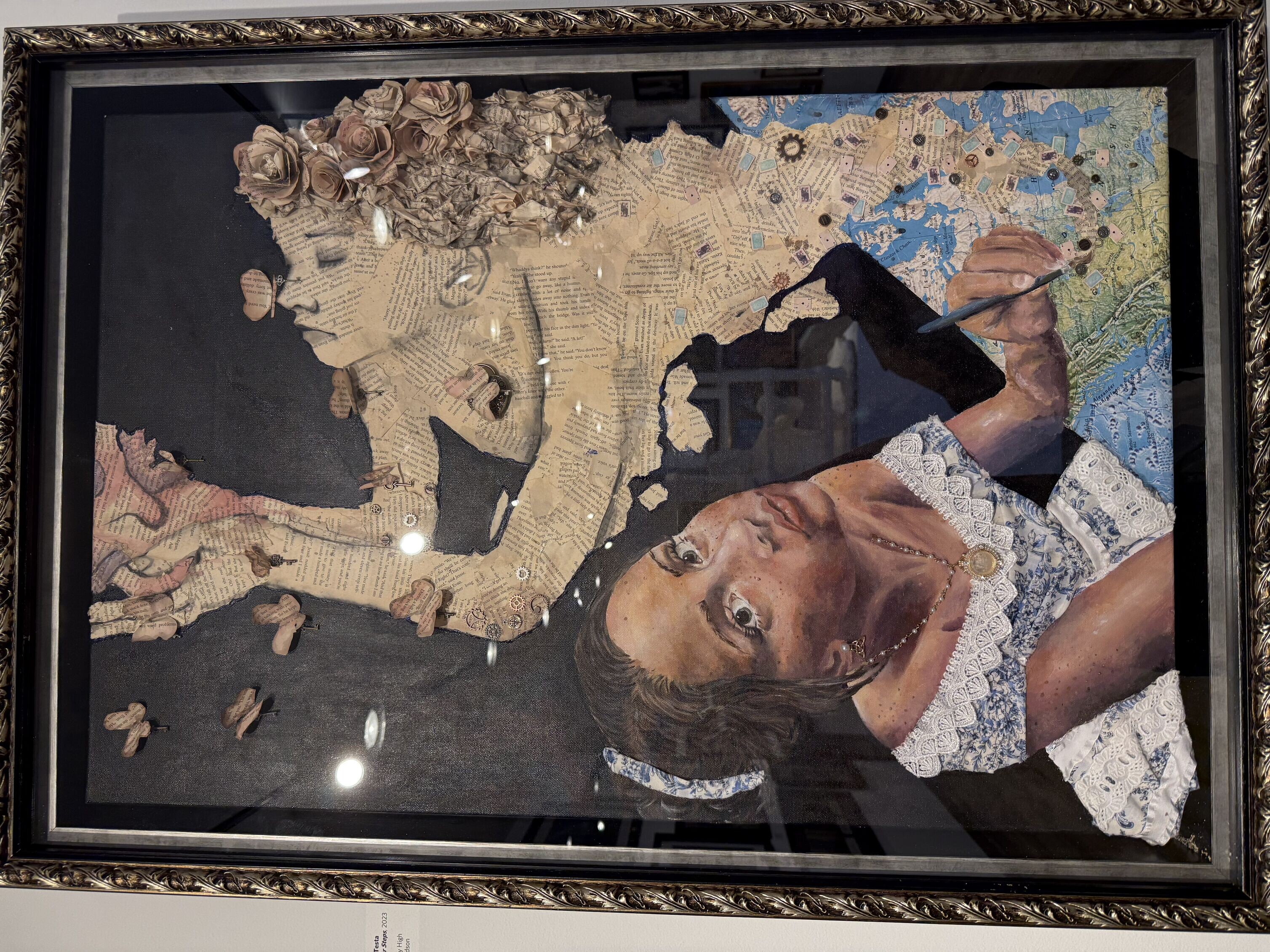
My favorite artwork from this gallery was a mixed media piece called Writer with a Paintbrush, created by Gatlinburg-Pittman student Kylie Patterson. This piece stood out to me the most because of the combination of paint with glued book pages and fabric and jewelry that form two different humans, and the powerful meaning of art telling a story.
The girl on the left has beautifully painted brown skin, with bronze cheeks and a pale pink nose that make her face realistically shaded. The detail on her dark brown hair is also impressive, with each lock standing out in natural waves and highlights; it looks like real, soft hair. Another feature to note on the girl is the fabric used for her dress and headband, as well as the gold necklace and earrings. Her dress pops out of the painting because it is real fabric with real folds and patterns, adding to the unique textures of the art piece as a whole. Moreover, her shiny gold necklace and earrings with pearls add to the third dimension of the art, emphasizing her natural beauty, as she is also shining like gold and purely natural like pearls.
The other girl is also a work of art, uniquely designed from book pages that are folded and cut into different shapes, with little 3D objects glued to her figure. The girl is arising from the paintbrush of the first girl, her own work of art. The girl made of paper and little objects has silver coins, keys, gears, and playing cards glued to the genie smoke tail coming out of the paintbrush, which I believe represents the little, random but unique features artists add to their work that set it apart from every other artwork. I also love the way the artist folded the paper on the girl’s hair to look like flowers, and the lightly painted and cut-out butterflies flying from the girl’s hands. These features add so much unique detail to the art.
I think using mixed media for this art piece was the right way to go because it displays how two forms of art—painting and writing—work hand-in-hand. Just like writing, painting can tell a story. You can see the characters, plot, and setting all from one artwork. The characters can be the physical beings in the artwork, or they can be an abstract concept that represents a character, such as shapes and colors. You can even see plot in a piece of art, which can be shown through the surroundings of the character, the color and tone of the piece, and the facial expressions of the characters. Setting is also included in art through the scene the characters are set in. I love that the painted girl is painting a story with her paintbrush, a story that creates a whole new being with its own unique shapes, colors, patterns, and words.
No-Man’s-Land Exhibit
One of the temporary exhibits at the Knoxville Museum of Art, which ran from August 13, 2026, to November 8, 2026, is No-Man’s-Land. This exhibit takes the vision of a Kentucky coal miner and artist named Harrison Mayes. He was born in Fork Ridge, Tennessee, in 1898 and had a near-death mining accident that gave him a revelation. Mayes began painting messages such as “GET RIGHT WITH GOD” across barns, and engraved them on crosses beside roads.
His handmade signs and markers reached 46 states and many countries; his ambitions extended even past Earth and to every planet and undiscovered celestial bodies. These markers were placed in what Mayes called “no-man’s-land,” the narrow space between state and private property, where no authority could charge him for trespassing.
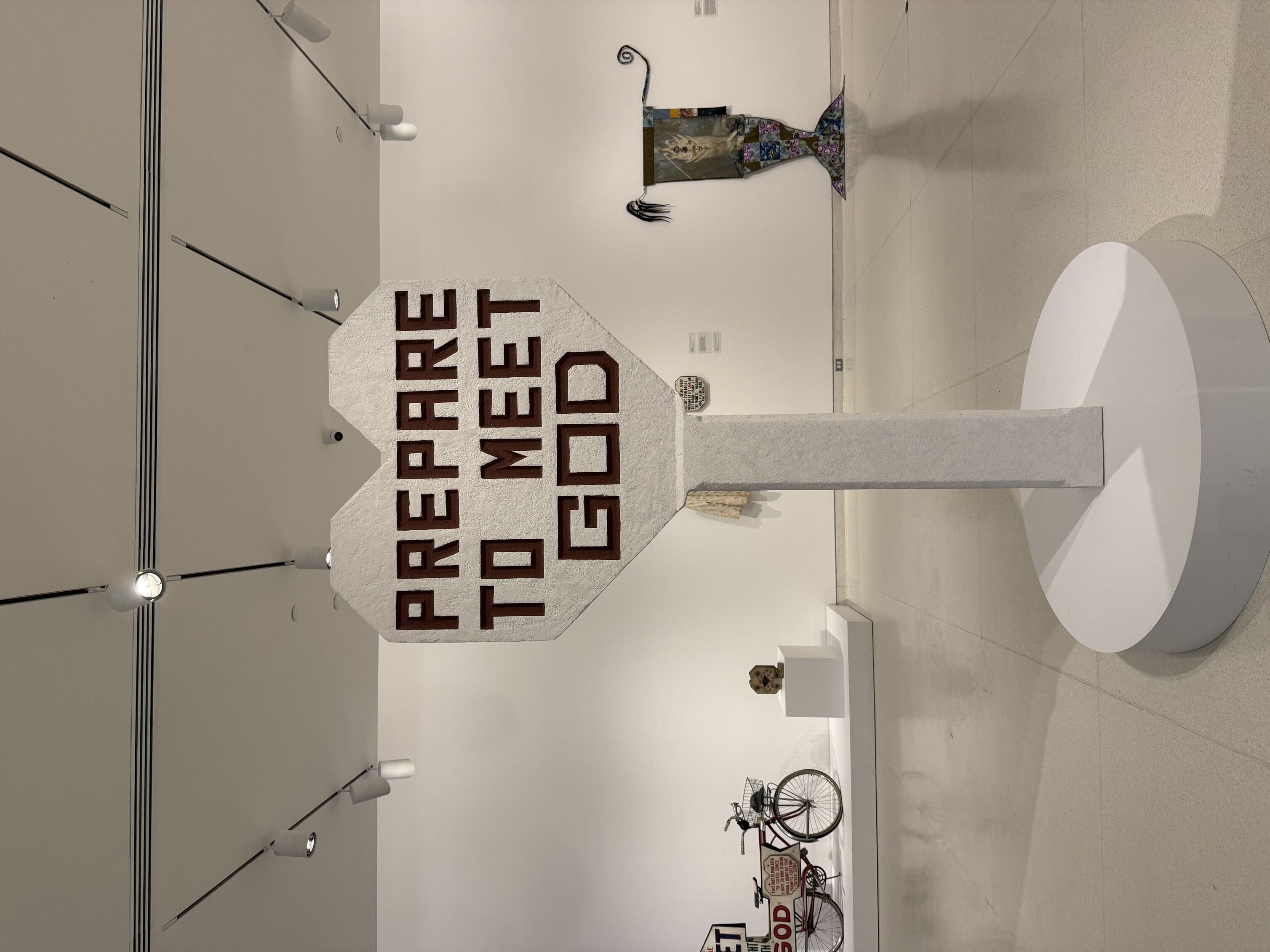
Similarly, the artists in this exhibit display artwork shaped by memory, migration, mythology, and ecological change while reaching towards other worlds. The spiritual and material worlds come together to form new and unconstrained borders that allow for art to go in any direction, which could be to another world. At the entrance of this exhibit, there is a “Prepare to Meet God” sign, letting you know about the ethereal and spiritual artwork you’re about to see.
Although all of the artwork in this exhibit is extraordinary and magical, there were two pieces that caught my attention due to their elaborate designs and interesting use of materials.
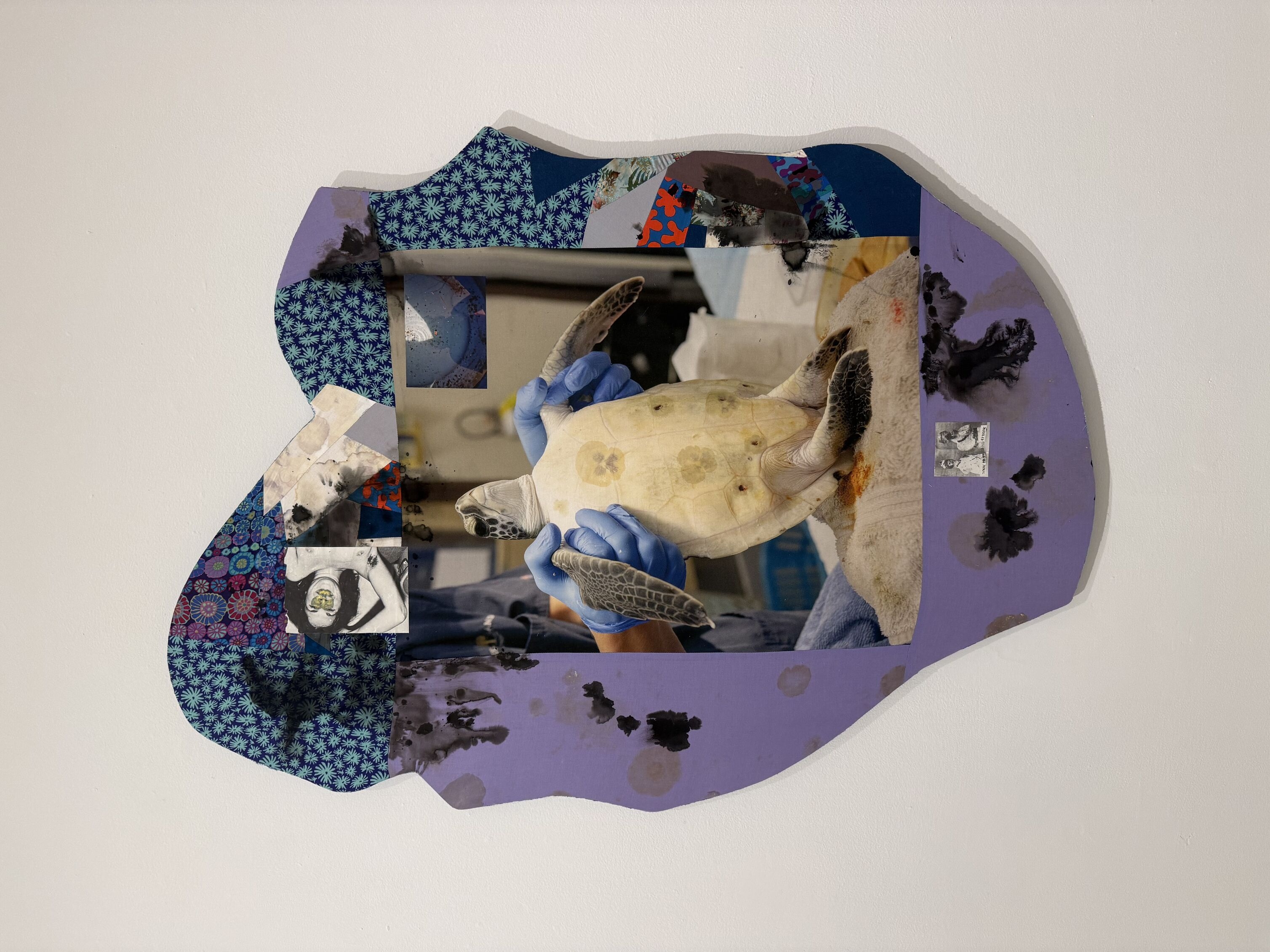
Erin Jane Nelson is an artist from Neenah, Wisconsin, and is now living in Santa Fe, New Mexico. Her artwork features pigment print on cotton, natural dyes, chromogenic print, photographs, and fabric to document the care, resources, funding cuts, and uncertain futures of injured sea turtle rehabilitation at the Jekyll Island Sea Turtle Hospital. Her artwork asks the questions: Whose lives are protected? What resources are sustained? How do those decisions become visible in the landscape?
Nelson’s work is a shaped panel with textile-printed photographs and pieces of fabric assembled like a quilt, which recalls the quilt-making traditions long practiced throughout the Southeast. The shapes and patterns are all uniquely different, with hardly any similarities to disrupt the expectation of similar shapes and repeating patterns in some art. This is to show that “sameness gives way to mutation and drift, suggesting that healing is not a return to an original state but a process of continual change”, according to the gallery wall label.
This art piece was a lot to behold at first, but when I paused to really look, I saw the beauty and diversity of nature in Nelson’s work. Everything in nature is unique; every individual of a species has a variation in appearance and behavior, so there is always something new to see. This idea of never-ending novelty emphasizes Mayes’ gospel of art being so unconstrained and magical that no other forms of art can be like it.
I loved the way Nelson included different fabric patterns and dyes behind the photograph of the sea turtle. The blue and coral-shaped designs on the fabric give the art an aquatic look to fit the theme of sea turtles, and the black and brown ink seems to represent the oil and waste pollution in the oceans that harm these marine creatures. I was not entirely sure what the black-and-white photograph below and above the sea turtle meant, but it made me think about the fact that humanity may only see the black-and-white of animal conservation and doesn’t give a lot of thought or care to the world of sea creatures that deserve to live in a home free of waste.
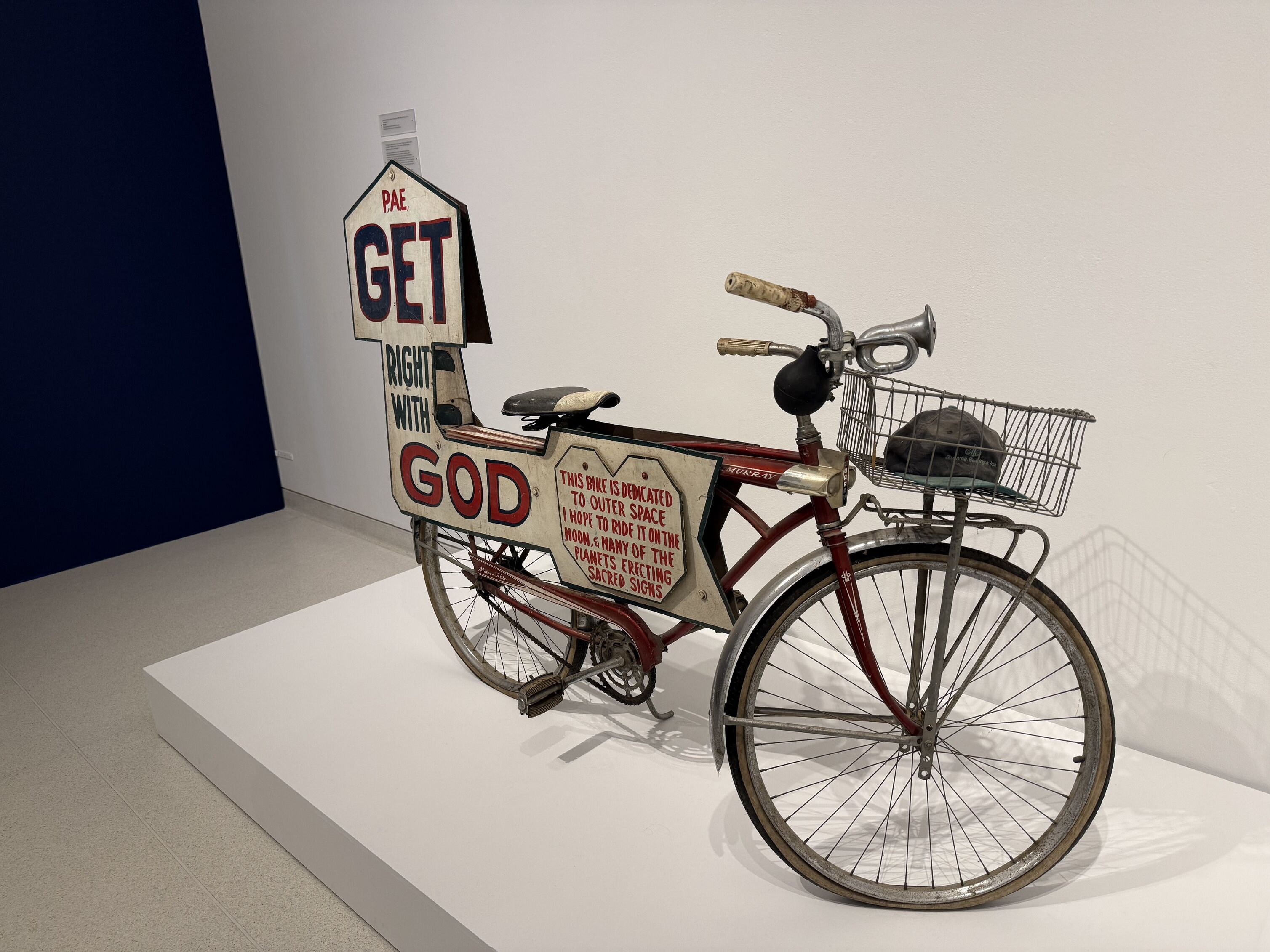
I was excited to see one of the works by the man who made this whole exhibit come to life, and I am happy to report that his artwork, Bicycle, was one of my favorites from this gallery. Mayes used paint and wood on his own bicycle to create a masterpiece.
On the frame of the bike, Mayes wrote, “This bike is dedicated to outer space. I hope to ride it on the moon and many of the planets erecting sacred signs.” A lot of his work features the idea of conviction, humor, prophecy, and invention like this. He transformed a lot of overlooked spaces into sites of spiritual declaration with his signs similar to the ones on the bike, and he wants to take those signs and beliefs to the worlds beyond Earth. The bicycle represents both a practical object and a visionary proposition, its destination being the next world and the one beyond because Mayes believes the distance between a roadside ditch and outer space is not as vast as it might seem.
I love how Mayes used wood and made it into the shape of an arrow pointing up with the painted words, “GET RIGHT WITH GOD”, which is the main message on his signs placed all around the world. I believe this represents the idea that humanity needs to get their hearts right with God to reach for a world beyond Earth: Heaven. Because Mayes saw the face of death while being a coal miner, he understands what dying without having God in your heart looks like, so he encourages others through his signs to make the right choice so they can go to Heaven. Although this piece can and will appeal to all viewers, as a Christian myself, I find this message scary but hopeful. Like most Christians, the thought of going anywhere else besides Heaven (in other words, Hell) after death is terrifying because no one wants to live in an eternity of suffering and pain.
bittersun Exhibit
The second temporary exhibit at the Knoxville Museum of Art was bittersun by Hai-Wen Lin, a Taiwanese-American artist who fashions garments as kites and creates sculptures that move between the body and environment. This exhibit will last from October 29, 2026, to February 21, 2027.
Lin believes that clothing offers a way of thinking about our relationship to the world around us, as we dress depending on the weather, an event, or even a mood. Inspired by their background in garment design, Lin thinks beyond the human body and imagines what a garment for the wind would mean under this idea. Much of Lin’s work includes drafting patterns, cutting fabric, and sewing pieces together, some of these works becoming kites, and some kites becoming fabric that could be worn. Lin’s work can take on different roles depending on how and where it is encountered.
The artist’s practices are shaped by their movement across homes, cities, and seasons, their travels leading to new encounters shaped by different people. Lin has memories of their mother quilting and of textile traditions from different places, connecting the different forms of textile-making across distances and generations. Likewise, Lin connects this idea to the work itself, considering what we carry with us, and what we leave behind, as our lives change.
bittersun displays Lin’s practice at an architectural level, focusing on a huge textile kite suspended within the gallery. On the fabric of the kite, there is a marriage of geometric traditions of Buddhist robes with Appalachian quilt-making. The creation of this kite took place in Corsicana, Texas, and is inspired by Lin’s encounters with kite-making traditions in Guatemala and Japan, as well as the artist’s time at the Arrowmont School of Arts and Crafts near Gatlinburg.
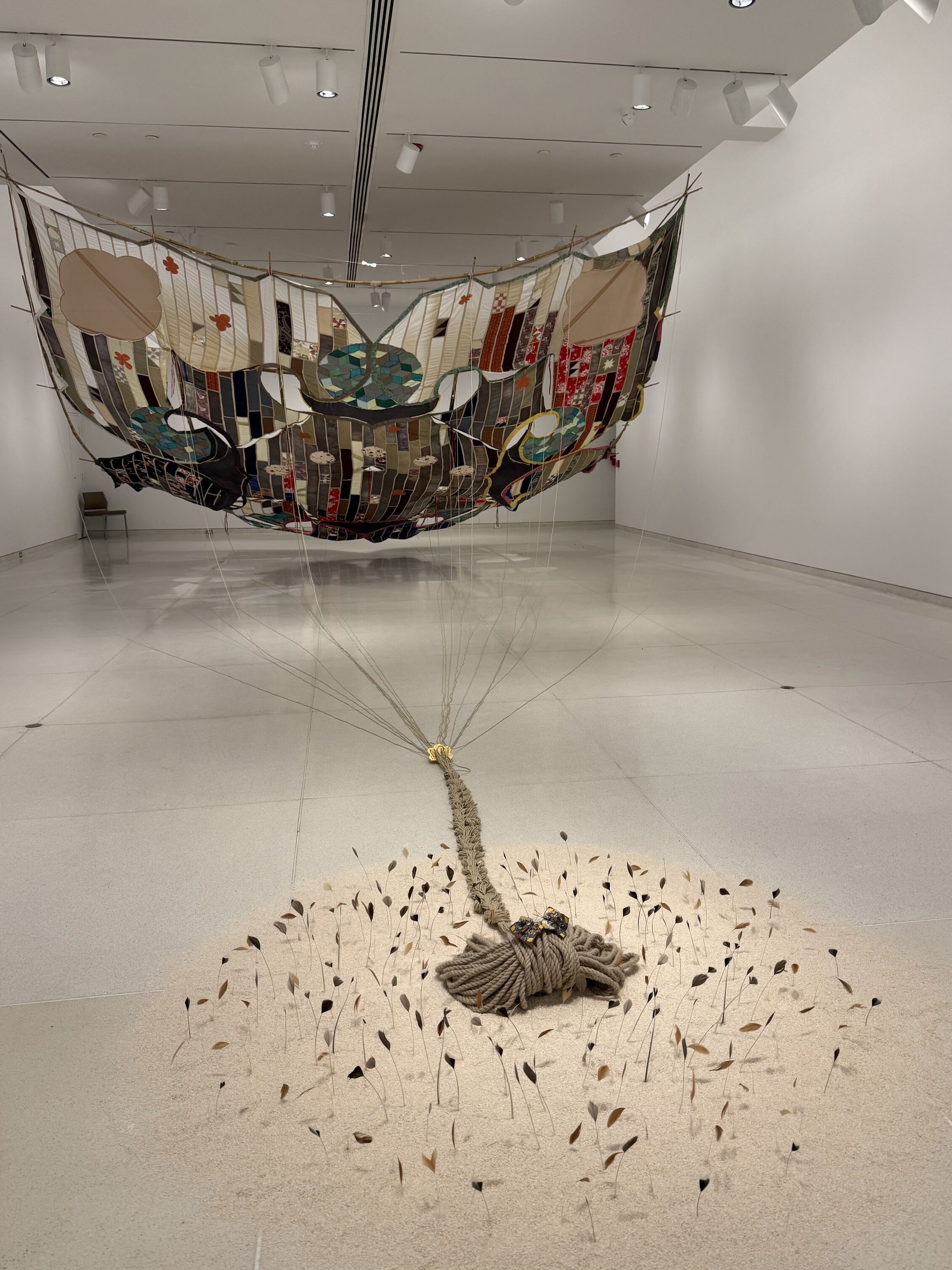
According to the museum’s assistant curator, Kelsie Conley, Lin captures the feeling of air being visible through a vast patchworked form suspended across the gallery, created by garment-making and stretched toward the limits of the sky. “The fabric gathers, sags, and pulls against its rigging, as if holding onto the memory of wind,” Conley wrote on the gallery wall. “A kite is made for movement, but here it hangs in a room where the atmosphere is carefully controlled.”
I thought it was interesting that the kite’s suspension in the air symbolized the possibility that something can endure without staying the same. You can see how its shape seems to shift as you walk around the kite, and how its size makes the room seem limitless, according to Conley. However, I was more engrossed with the color and patterns on the kite’s fabric, as well as the stories they tell.
I love how each line of fabric is a different color or has a different shape on it. From left to right, you can see shapes similar to flowers, stars, diamonds, pixels, and leaves. From top to bottom, you can see a change in color on the fabric, going from lighter shades of beige and cream to dark tones such as navy, grey, black, brown, and red.
The changes in shapes throughout the kite represent all the cultures that have influenced this work of art. The pixels and diamonds look similar to the shapes in Appalachian quilts, and the leaf patterns look similar to the patterns on the robes of Buddhists. These are remnants of traditions and history that are kept alive. Moreover, I believe the colors going from light at the top to dark at the bottom represent the idea that reaching for the skies is bright and hopeful, while remaining on the ground is dark and boring. You will only ever change if you reach as high as you can, while staying attached to the ground will stop you from experiencing the joys and mysteries of life.
The kite being the main object in the room is also significant to note. It may be considered one piece of artwork in this exhibit, but it features hundreds of years of art throughout history. All the patterns and colors are inspired by textiles from the past, whether that be from Buddhism, Appalachia, or other cultures, traditions, and beliefs. I find including so much art in one piece to be fascinating, as if the artwork is showing us that there are hundreds of other art pieces that have influenced and shaped this one huge piece.
Explore Our City of Art
Even as someone who isn’t a major art geek, the new and temporary exhibits from the Knoxville Museum of Art were so intriguing to me. I enjoyed seeing all the student art from around Knoxville because each piece of art, whether it was a drawing, painting, photograph, or mixed media piece, had details and features that were unlike any other piece within that gallery; they were all so different and told unique stories. Similarly, the art from the No-Man’s-Land exhibit featured Mayes’ idea of art being so boundless that it could reach for other worlds beyond Earth. Lastly, Lin’s kite held so many stories within the patterns and shapes on the fabric, highlighting the differences in cultures and traditions that influence artwork.
We have access to one-of-a-kind art in Knoxville. The city has alleyways full of vibrant murals, statues of significant people in history, and a museum with local and astonishing art. Next time you visit downtown, go to the Knoxville Museum of Art to see the new exhibits before they leave. The temporary exhibits such as No-Man’s-Land and bittersun will eventually become new exhibits, so you’ll have new artwork to behold.
Take advantage of the fact that we have talented artists in Knoxville who create such beautiful pieces of artwork. There is really nothing else that compares to the creative minds and hands of our city.