
By Addison Chrivia, Managing Editor, Patrick Dobyns, Editor and Katherine Long, Cartoonist
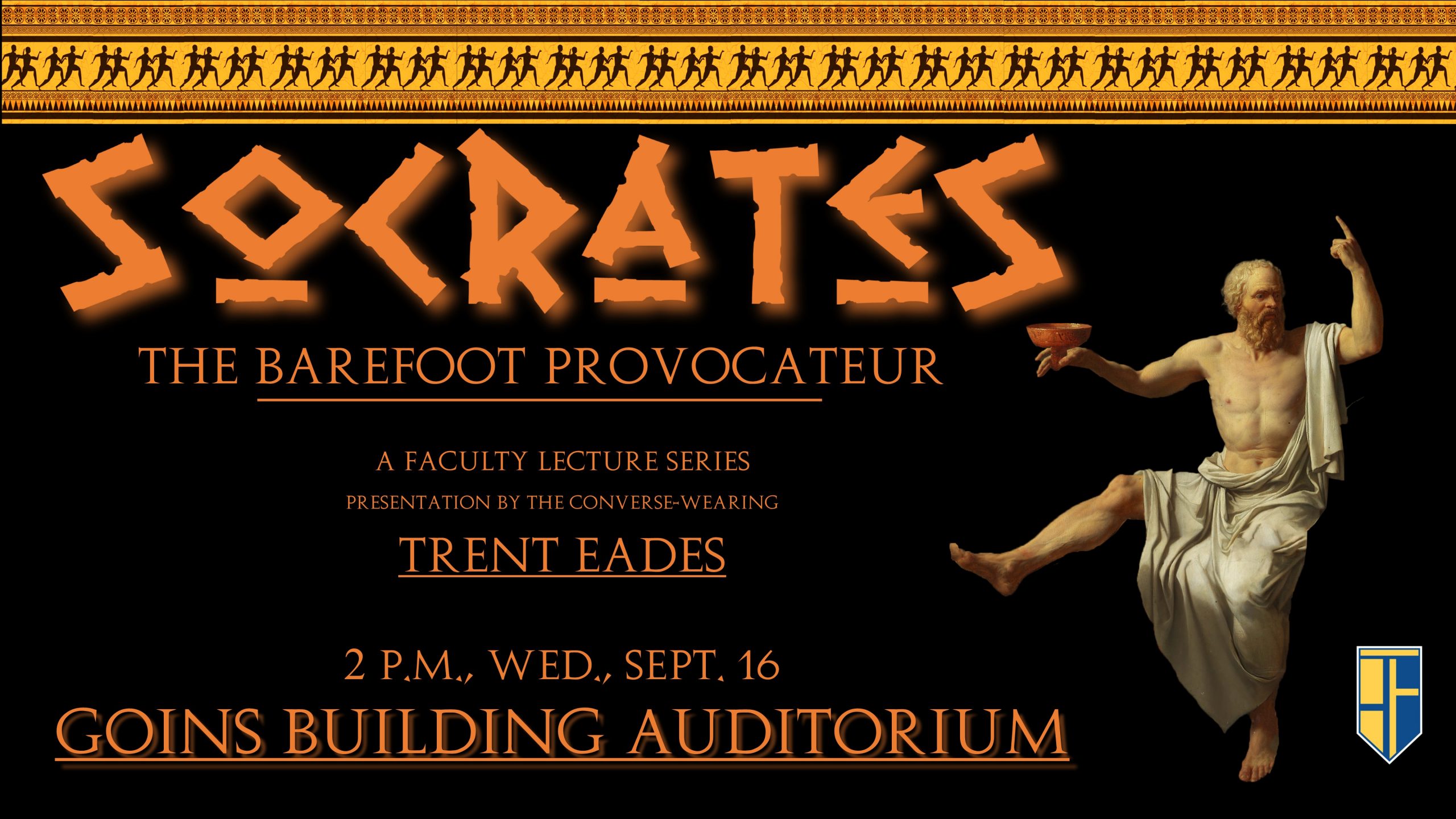
On September 16, Professor Trent Eades took the stage to share what he learned from Plato’s Socrates in a lecture titled “Socrates: The Barefoot Provocateur.” Eades based his lecture on his lifelong love of the Platonic dialogues, sharing his takeaways from seeing Plato’s Socrates as a “moral exemplar.” Eades connected each of his points inside the lecture to the outside world, showing his audience how the teachings of “an ancient hemlock drinker” still matter today.
As a quick introduction, Socrates was one of Greece’s preeminent philosophers, active in the fourth century BCE. He was primarily known for questioning people’s knowledge of things they were supposed to be experts on, often revealing that they had little true knowledge. He did not claim to be any wiser than them, however, and is famously credited as saying, “I only know that I know nothing.” His questions are the foundation of critical thinking and discovery. Despite this, he was never really a teacher. He only encouraged people to think for themselves, rather than rely on other people’s knowledge or stories, he wanted evidence before he accepted something as true, and stories of the gods were not enough evidence. Because of this, he was charged with corrupting the youth and impiety and executed in 399 BCE.
Professor Eades’ lecture was not, however, about the history of the life of Socrates. In fact, he very specifically stated that at the very beginning of the lecture. Many have tried to disentangle the true life of Socrates from the dialogues of Plato and his contemporaries. But as Socrates wrote nothing himself, this is difficult, and in all honesty, pointless. Socrates is remembered through these dialogues, and it is this version of Socrates that Eades discussed with the audience.
Why did Eades choose Socrates to cover? As a former journalist and current English professor, it doesn’t seem like an ancient philosopher is the obvious choice for a faculty lecture. However, Eades shared that Socrates, more than any literature, shaped the way he thinks about the world. Socrates taught him moral courage, intellectual honesty, the difference between rhetoric and philosophy, the need to modify your approach to different people, and to be wary of speeches, charismatic speakers, and those who seek power. Those are exactly the skills that a journalist and teacher need. Some of the most important things you learn in life will not come from the classes related to your major, or those sources you continually revisit, but from subjects and genres outside of your knowledge. That is what will truly broaden your understanding of the world and shape who you are.
Throughout the lecture, Eades builds to the conclusion that life’s most important goal is to improve oneself, starting with vital qualities one must improve upon to live a better life. He first highlighted moral courage, which he defined as the strength of character to stand up for one’s principles and the truth. He pointed out that moral courage both requires and is formed by constant questioning, especially when there is no easy answer.
For instance, the questions Eades offered to help develop moral courage were, “What kind of person am I? What kind of person do I want to be? How cheap are my principles?” Following this, he discussed the importance of intellectual honesty, the goodwill required to accept valid points and introspect in order to, as Eades put it, “find the best account of things.” He implied one must honestly examine everything to develop effective moral courage. Eades asserted that these traits contribute to a person’s development, and that intellectual honesty is a vital part of philosophy and learning.
Rhetoric vs. Philosophy
One of Socrates’ most hated rivals was the Sophists. These were people who made a career out of public speaking and debating. The problem was that these were the people who claimed to have knowledge that they were, in reality, lacking. He believed it was much more desirable to be knowledgeable instead of persuasive, and this was the primary point of contention. Eades spoke about what critical thinkers need to be wary of in modern-day Sophists. He says to be wary of speeches and those who are charismatic speakers. Obviously, not all who speak publicly are acting maliciously; however, charismatic speakers have a tendency to get audiences to think a certain way without actually thinking for themselves — it’s anathema to critical thinking. Eades gave us a list of some of history’s best speakers, putting names like Martin Luther King and Barack Obama alongside Margaret Thatcher and Adolf Hitler.
Questioning everything, being skeptical of easy answers, and making others question themselves was the basis of Socrates’ discussions. This sort of toddler-like curiosity about the world demolished the carefully made speeches of some of the best philosophers of his era. In a world filled with generative A.I and content prioritizing quick views and clicks rather than honesty, being skeptical of information is a vital skill for everyone to learn. What Socrates teaches students nowadays is to question everything. Look deeper than the surface, and if something seems too easy, if the speaker is powerful and charismatic, ask questions.
The Faculty Lecture Series was founded in 2010 by Trent Eades, Rob Lloyd, and Keith Norris to allow students to explore a variety of topics through three unique lectures each semester. Eades, when asked after the lecture, said he started the series because he loved attending lectures in college and wanted to give students that chance, since “that’s what college should be,” according to Socrates.
That’s why it’s important to have faculty lectures, and for students to attend them. Broadening your knowledge expands your view of the world and allows you to see the big picture. It helps you pick up on little inconsistencies and become more critical of easy information. Faculty lectures are a great way to learn a little more about the world from someone else’s perspective and understand what they believe is important to learn from a verified academic.
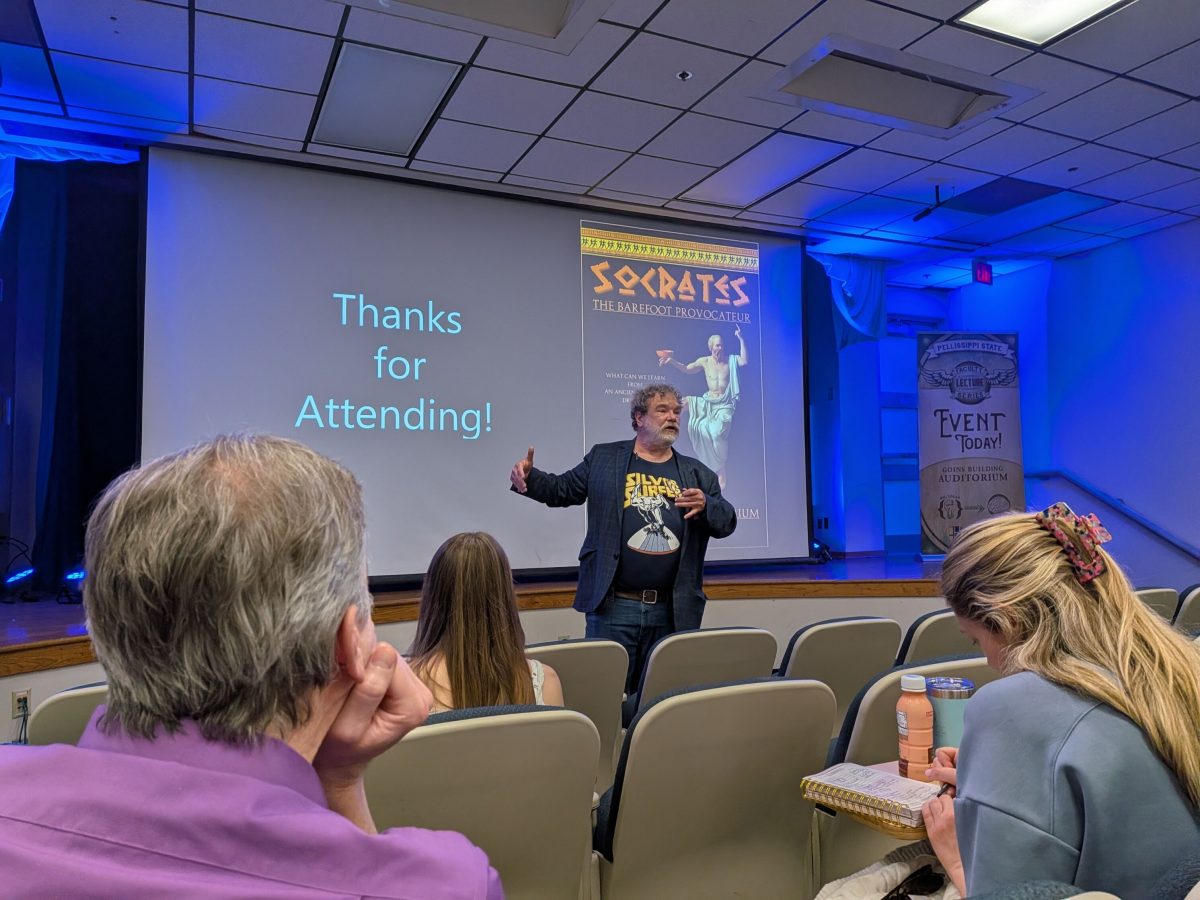
Trent Eades concludes his lecture | Photo by Addison Chrivia
Eades says, “In an academic setting, being exposed to other ideas that you’re not familiar with is just part of what it is to be a student, part of what it is to learn about the world. And besides, it’s great fun.”
So, attend every lecture, be open to new information, be skeptical of charismatic speakers, and question everything so you can learn something. To close out, some final advice from Eades: “Keep your mind and eyes open.”